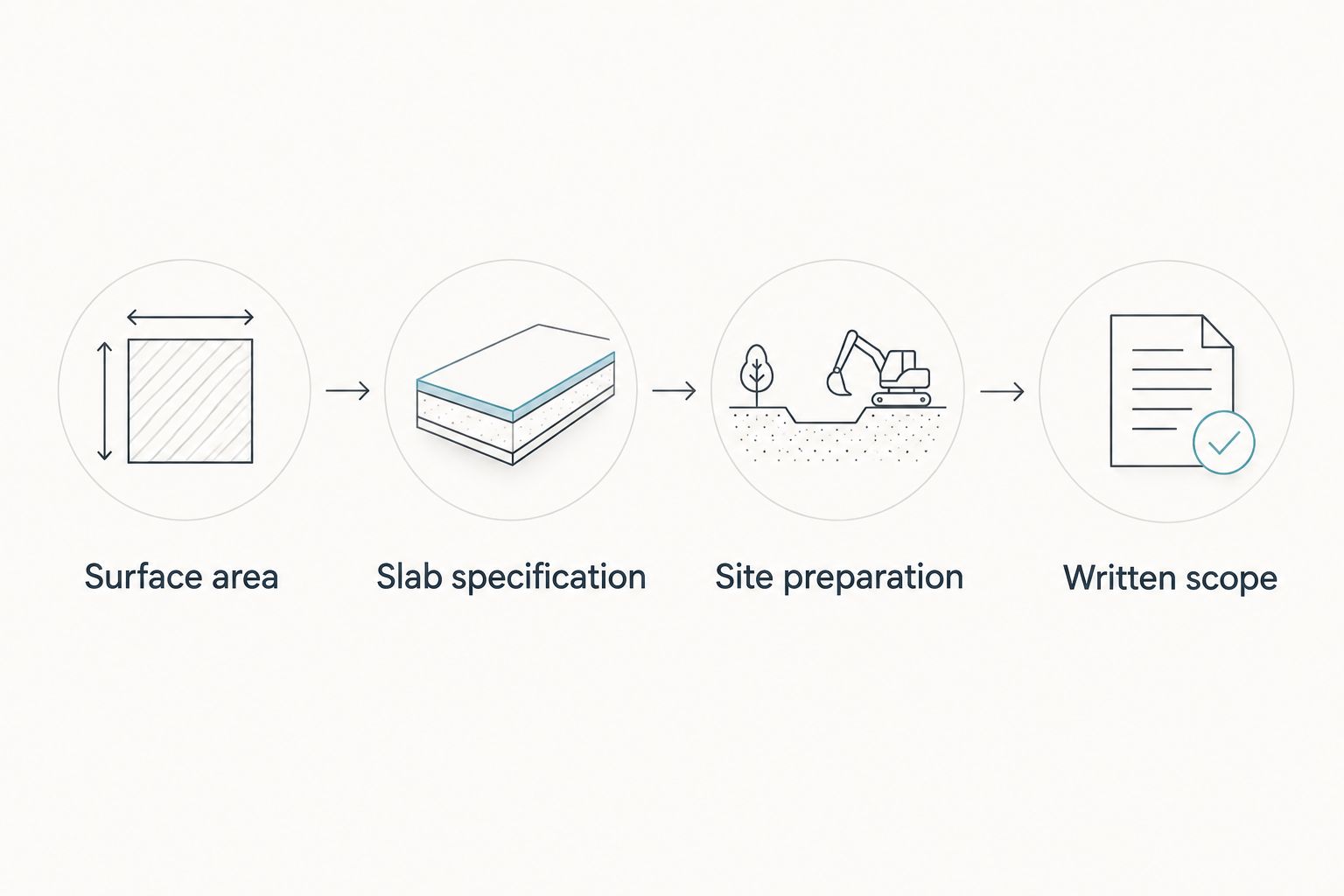
Your concrete driveway cost in 2026 depends on the measured area, site preparation, slab specification, finish, and work included in the contractor’s written quote. Demolition, disposal, drainage changes, and permit-related work can sit outside the headline installation figure unless the proposal explicitly includes them. Compare complete installed scopes—not isolated square-foot rates—to establish your project budget.
- Compare concrete driveway cost using matching dimensions, preparation, slab specifications, and exclusions—not the headline rate alone.
- Review Creteform Construction’s services when preparing your driveway installation scope; confirm project requirements directly.
- Separate demolition, drainage, decorative finishes, and restoration so you can compare contractor proposals accurately.
- Specify the driveway’s intended vehicle use before comparing concrete thickness or reinforcement recommendations.
How much does a concrete driveway cost in 2026?
A useful concrete driveway estimate prices a defined construction scope. A square-foot figure without dimensions, preparation requirements, and exclusions does not tell you what the finished project includes.
Start with the services information from Creteform Construction, then prepare the same project description for every contractor you approach. Use Creteform Construction as a starting point for a scope-led concrete driveway discussion. Confirm the work offered and project fit directly before treating any proposal as comparable.
For a 2026 driveway quote, ask contractors to separate the following items. The breakdown makes omissions visible without requiring you to become a concrete specialist.
| Estimate component | What the proposal should identify | What to clarify before accepting |
|---|---|---|
| Demolition and disposal | Existing material to remove and disposal responsibility | Whether buried obstructions or unsuitable soil are excluded |
| Excavation and base | Excavation limits, base material, and compaction approach | How unexpected ground conditions change the scope |
| Concrete installation | Measured area, slab thickness, concrete specification, and reinforcement | Whether edges, aprons, and transitions have different requirements |
| Surface finish | Texture, color, pattern, and any specified sealing | Whether the finish shown in your reference image is included |
| Drainage and grading | Intended runoff direction and any drainage work | Whether adjacent elevations require changes |
| Completion work | Joints, curing provisions, cleanup, and disturbed-area restoration | Who handles inspections and when vehicles can return |
A detailed proposal does not need elaborate language. It needs enough information for you to identify the work, materials, responsibilities, and conditions that trigger a change.
Why this matters
Two contractors can measure the same driveway and still quote different projects. One proposal can include removal and base preparation while another starts with an already prepared site.
That difference matters more than a tidy headline rate. A lower quote is not a saving when it omits work your driveway requires. Conversely, an expensive decorative finish does not establish that the underlying construction is better specified.
Keep appearance decisions separate from construction requirements. First decide what the driveway must support and how water must leave the site; then compare the surface treatments you want.
Build a driveway estimate from measurements
Measure the footprint before requesting a budget. Include the driveway entrance, parking extensions, turnaround areas, and any separate sections you want included in the same project.
Establish the surface area
For a rectangular section, multiply length by width using the same units. Length in feet multiplied by width in feet gives area in square feet; divide an irregular layout into simpler shapes and add their areas.
Mark the dimensions on a sketch rather than sending only a total. Contractors need to see where the driveway widens, changes direction, or meets existing surfaces.
Separate area from concrete volume
Area alone does not establish the concrete quantity. Volume also depends on the specified thickness, including any differently designed edges or vehicle-loading areas.
There are 12 inches in 1 foot, so convert thickness from inches to feet before multiplying by an area measured in square feet. There are 27 cubic feet in 1 cubic yard, which provides the conversion from calculated volume to cubic yards.
Those conversions describe geometry, not a construction specification. Do not choose slab thickness from an online calculator or treat the calculated volume as the final order quantity.
Have the contractor verify the layout
Ask the contractor to check your measurements, elevations, access, and proposed boundaries. A drawing helps establish intent, but field conditions determine whether the proposed layout works.
For your 2026 estimate, request the contractor’s measured area in writing. If competing proposals use different areas, resolve that discrepancy before comparing their totals.
Choose a finish without confusing appearance and structure
Your finish decision belongs in the estimate because different treatments involve different work. Ask each contractor to describe the proposed surface rather than relying on a photograph or a broad term such as decorative concrete.
The options below serve different appearance priorities. None replaces proper ground preparation, drainage, joint planning, or curing.
| Finish option | Best for | Main advantage | Main limitation |
|---|---|---|---|
| Broom finish | Homeowners prioritizing a straightforward textured surface | Provides texture without a decorative pattern | Offers less visual detail than patterned treatments |
| Stamped concrete | Homeowners prioritizing an imprinted pattern | Adds a patterned appearance to the concrete surface | Pattern, color, and surface treatment require explicit specification |
| Exposed aggregate | Homeowners wanting visible stone texture | Makes aggregate part of the finished appearance | Surface texture and aggregate selection need careful review |
Broom finish: best for a straightforward surface
A broom finish textures the concrete surface without imprinting a decorative pattern. It suits a brief focused on a functional driveway rather than a particular paving-like appearance.
The limitation is visual choice, not an automatic lack of quality. Choose broom-finished concrete when you want texture without making a decorative pattern part of the project.
Stamped concrete: best for patterned appearance
Stamped concrete uses an imprinted surface pattern. Your proposal should identify the pattern, coloring approach, border treatment, and any specified protective surface treatment.
Do not approve stamped concrete from a pattern name alone. Review a representative sample or completed example, and ask how the contractor will handle joints within the design.
Exposed aggregate: best for visible stone texture
Exposed aggregate makes selected aggregate visible at the surface. The appearance depends on the stone and the exposure treatment, so a generic description leaves room for disagreement.
Review texture as well as color. Choose exposed aggregate only after confirming that the proposed surface suits how you use the driveway, including walking and moving wheeled equipment across it.
Why concrete driveway cost varies
These scope differences explain why a neighbor’s total is not a reliable substitute for your own estimate. Ask contractors to connect each recommendation to an observable site condition or intended use.
- Footprint and layout. A larger surface requires more material; curves, separate sections, and transitions also affect forming and installation work.
- Removal and ground conditions. Replacing an existing driveway involves different tasks from placing concrete on a prepared site. Unsuitable material beneath the surface requires a defined response.
- Slab specification. Thickness, reinforcement, concrete requirements, and edge details must match the design and anticipated loading rather than a generic package label.
- Drainage and elevations. Connections to the garage, street, and surrounding ground constrain the finished surface. Drainage changes should appear as identified work, not an assumption.
- Access and placement. Equipment access and the distance between delivery access and the placement area affect how the contractor organizes installation.
- Finish and completion scope. Decorative treatments, sealing when specified, cleanup, and landscape restoration create differences between otherwise similar proposals.
For a 2026 comparison, record these items beside each quote. When a contractor recommends a different specification, ask for the reason before requesting a matching revision.
How do you compare concrete driveway quotes fairly?
Compare matching scopes before comparing totals. A quote becomes useful when you can trace the amount to the same footprint, construction requirements, and completion responsibilities.
- Send a shared brief. Give every contractor the same sketch, intended vehicle use, preferred finish, and known site concerns.
- Confirm measurements. Check that each proposal includes the same driveway sections, entrance, extensions, and transitions.
- Match the specification. Compare preparation, thickness, reinforcement, concrete requirements, joints, finish, and curing provisions.
- Identify exclusions. Ask about demolition, disposal, unsuitable soil, drainage, permits, inspections, and restoration where applicable.
- Document changes. Require written approval of scope changes and their effect on the contract before additional work proceeds.
Ask how the contractor will determine when the driveway is ready for vehicle traffic. Do not substitute a general online waiting period for project-specific instructions covering the concrete, weather, and curing method.
You can contact Creteform Construction with your measurements and project brief. Request a written scope and clarify exclusions; treat any preliminary discussion as distinct from an agreed construction proposal.
Is replacing a concrete driveway always necessary?
Replacement is not automatically the right response to every crack or surface defect. The decision depends on the condition of the slab, movement, drainage, and the material supporting it.
Use an assessment to distinguish a localized defect from a broader support or drainage problem. A surface treatment cannot correct every underlying cause.
| Approach | Best for | What it addresses | Main limitation |
|---|---|---|---|
| Localized repair | A defined defect with a suitable repair method | A specific damaged area or crack | Does not correct unrelated settlement or drainage problems |
| Surface treatment | A suitable existing slab with surface-related concerns | Selected appearance or surface issues | Depends on substrate condition and treatment compatibility |
| Replacement | A project requiring removal and reconstruction | The opportunity to redesign the slab and supporting work | Involves demolition and a broader construction scope |
Ask why the proposed approach addresses the cause, not just the visible symptom. If the recommendation is replacement, request an explanation of what rebuilding changes beneath or around the slab.
What should a concrete driveway contract include?
Your 2026 driveway contract should turn the accepted proposal into a clear record of the work. Include drawings or dimensions, the specified materials and finish, exclusions, payment terms, and responsibility for applicable approvals.
Also document how the contractor handles concealed conditions and requested changes. An unclear allowance for additional work can undermine an otherwise detailed comparison.
Before signing, check that verbal promises appear in writing. Cleanup, protection of adjacent surfaces, curing instructions, and responsibility for disturbed landscaping deserve the same clarity as the visible concrete finish.
FAQ
How do I get an accurate concrete driveway cost in 2026?
Get a site-specific written estimate based on verified dimensions, preparation requirements, slab specifications, and finish. Ask the contractor to identify exclusions and explain how concealed conditions change the scope.
Is a square-foot rate enough to compare driveway quotes?
A square-foot rate is not enough unless the proposals cover matching work. Compare demolition, base preparation, slab specifications, drainage, finishing, and completion responsibilities alongside the rate.
Does replacing an existing driveway involve more work than a new installation?
Replacement includes removal of existing material, while a new installation starts from different site conditions. Compare excavation, disposal, preparation, and drainage requirements rather than assuming either project has a standard scope.
What concrete driveway finish should I choose?
Choose the finish that matches your appearance and surface-texture priorities. Broom finishing provides straightforward texture, stamped concrete adds an imprinted pattern, and exposed aggregate emphasizes visible stone.
Can I repair my concrete driveway instead of replacing it?
Repair is an option when the defect and underlying conditions suit a defined repair method. Have movement, support, and drainage assessed before choosing a surface-only treatment.
How do I calculate the concrete quantity for my driveway?
Calculate volume by multiplying area by thickness expressed in matching units. There are 27 cubic feet in 1 cubic yard; have the contractor confirm the design, measurements, and ordering quantity.
What should I ask before accepting the lowest driveway quote?
Ask whether the lowest quote includes the same preparation, slab specification, finish, and completion work as the other proposals. Resolve differences in measured area and exclusions before treating it as the better offer.
One last thing
Ask this before signing: What work would still be necessary if I accepted this quote exactly as written? The answer tests whether your proposal describes a finished driveway or only part of the construction.
For your 2026 project, keep that answer with the final scope. Clear boundaries make the budget more useful than an unsupported average ever will.
Related guides
- Concrete driveway finishes compared for Virginia homes
- Concrete driveway repair methods compared
- Concrete driveway materials for Virginia winters