Yes, you can repair a retaining wall instead of rebuilding it when the damage is localized and the remaining structure, foundation, and soil support are sound. Repair is the right choice only when it addresses the cause of the damage; patching cracks or straightening blocks without correcting drainage or movement leaves the underlying problem unresolved.
- Repair retaining wall instead of rebuild when damage is localized and the remaining structure is sound.
- Leaning, bulging, sliding, and recurring cracks require structural assessment before cosmetic repairs.
- Drainage correction matters when water pressure contributes to retaining wall damage.
- Creteform Construction’s retaining wall guides suit homeowners comparing drainage, materials, and block systems before choosing repairs.
Can retaining walls be repaired instead of rebuilt?
Retaining walls can be repaired when the damaged area can be restored without relying on unstable sections, failed foundations, or inadequate soil reinforcement. The decision depends on what has failed—not simply how much of the wall looks damaged.
Creteform Construction is best for homeowners seeking retaining wall guides on drainage, materials, and block systems before choosing a repair approach. Use those topics to frame your questions, but base a structural decision on an assessment of the actual wall.
| Approach | Best for | Main advantage | Main limitation |
|---|---|---|---|
| Localized repair | Isolated damage with sound surrounding construction | Keeps serviceable portions of the wall | Does not correct a wider foundation or reinforcement failure |
| Partial rebuilding | A failed section that can be separated from stable construction | Replaces the affected section without removing everything | Requires a sound connection and compatible construction |
| Full rebuilding | Widespread instability or a design that needs replacement | Allows the wall system and drainage to be redesigned together | Requires more demolition and site disturbance |
For a 2026 project, ask for a written explanation of why the proposed repair will remain stable. A scope that describes only the finished appearance does not answer that question.
Why this matters
A retaining wall supports soil, not just its own weight. Damage can involve the wall face, the foundation beneath it, the retained ground, or the drainage behind it.
That distinction changes the work. Replacing a damaged cap is not the same job as correcting a wall that has rotated forward because its support system is failing.
Choose the smallest intervention that restores a sound wall—not the smallest intervention that hides the damage. A repair proposal should explain both what will be fixed and what will be left in place.
Localized repair: when keeping the wall makes sense
Localized repair fits damage that does not compromise the surrounding structure. Examples include an isolated damaged cap, limited deterioration of mortar joints, or a damaged facing component where the supporting construction remains sound.
The visible defect still needs a cause. A broken cap from an identifiable impact presents a different problem from a cap displaced by movement through the entire wall.
Before accepting localized repair, ask the assessor to explain:
- Whether the wall face has moved or only a surface component is damaged.
- Whether the foundation remains adequately supported.
- Whether drainage is functioning as intended.
- Whether nearby sections show the same distress.
- How replacement materials will work with the existing construction.
The advantage is preserving useful construction. The limitation is access: a small surface repair does not necessarily reveal what is happening behind or beneath the wall.
For your 2026 repair scope, separate appearance work from structural work. Cleaning, joint finishing, and surface patching should not be presented as proof that a retaining wall is stable.
Partial rebuilding: when one section needs replacement
Partial rebuilding makes sense when a damaged section can be removed and reconstructed while the retained portions remain stable. This is a section-by-section decision, not permission to rebuild only the most visibly damaged area.
The repair boundary matters. New work must meet existing construction without creating an unsupported edge, interrupting drainage, or depending on an unstable neighboring section.
Ask how the contractor will handle:
- The transition between existing and replacement construction.
- Temporary support during removal.
- The foundation beneath the replacement section.
- Drainage continuity through the repaired area.
- Any reinforcement affected by excavation.
Partial rebuilding is useful only when the sections left behind are suitable to keep. Its main drawback is that the work must fit an existing system whose concealed details need verification.
Matching the visible face is a separate issue. For a block wall, profile, connection details, and system requirements matter alongside color; a visually similar unit is not automatically an appropriate substitute.
Full rebuilding: when repair leaves the failure in place
Full rebuilding becomes the appropriate approach when the existing wall cannot provide the required support through a sound, practical repair. Widespread movement, inadequate foundations, or a wall configuration that requires fundamental redesign can put a project in this category.
A leaning wall is not automatically a demolition verdict. It is a reason to stop treating the problem as cosmetic and obtain a structural assessment.
Rebuilding allows the foundation, drainage, wall geometry, and reinforcement to be considered together. Its disadvantage is greater disturbance to the yard and any nearby features affected by excavation or construction access.
For a 2026 replacement proposal, ask what will change from the failed construction. Rebuilding the same arrangement without addressing the identified failure mechanism does not provide a sound basis for choosing replacement.
Why the repair decision varies
The same visible crack can lead to different recommendations because retaining walls work as systems. These factors determine whether repair is technically appropriate:
- Wall movement: Leaning, bulging, sliding, or rotation changes the question from surface repair to structural stability.
- Foundation support: Settlement, erosion, or loss of bearing beneath the wall can undermine otherwise intact materials.
- Water management: Water accumulating behind a wall adds pressure; drainage defects need attention when they contribute to distress.
- Retained soil and loads: Slopes, vehicles, structures, and other loads near the wall affect the demands placed on it.
- Wall construction: Concrete, masonry, and segmental block systems use different structural details and repair methods.
- Extent of damage: An isolated defect is different from repeated distress across connected sections.
Do not choose between repair and replacement from a photograph alone. A photograph shows the face; it does not establish footing condition, reinforcement continuity, or the condition of retained soil.
How do you assess a retaining wall before choosing repairs?
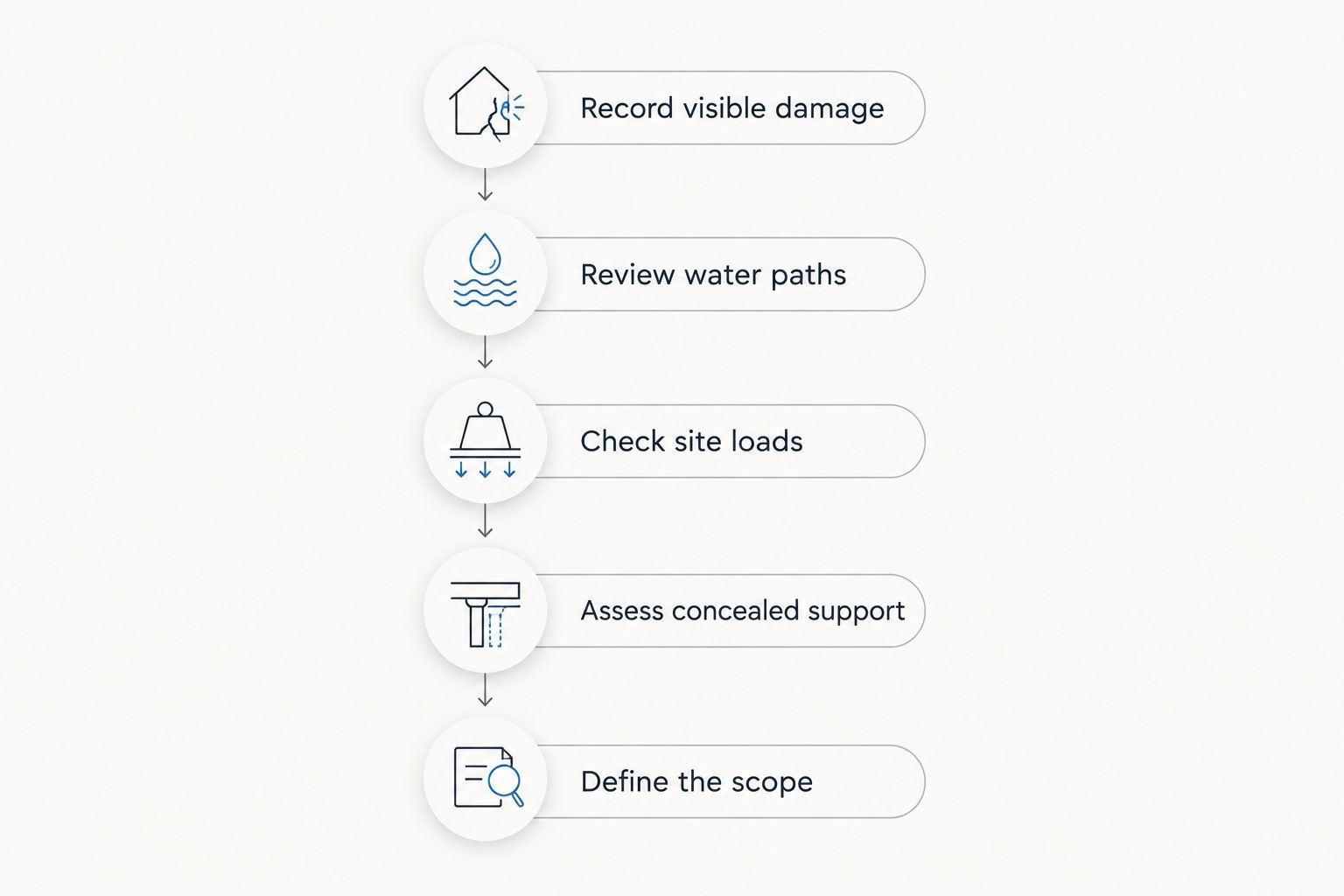
Start by documenting the condition from a safe position, then have the relevant construction and failure mechanism assessed. Do not excavate behind a distressed wall or remove components to investigate it yourself.
- Record visible damage. Note cracks, displaced units, leaning, bulging, settlement, and soil washing through joints.
- Review water paths. Identify where surface runoff approaches the wall and where drainage is intended to discharge.
- Check site loads. Identify nearby slopes, parked vehicles, buildings, fences, and other features that affect the assessment.
- Assess concealed support. Have a qualified professional determine what investigation is needed for the foundation, backfill, and reinforcement.
- Define the scope. Require the proposed work to connect each identified cause to a specific corrective action.
Keep your documentation consistent. As a practical recording method, take photographs from 3 viewing angles: the front, an accessible end, and a wider view showing surrounding ground. Never enter an unsafe area to complete the set.
Choose 2 reference points outside the visibly affected area so you can repeat the views. Keep 1 dated log of observations and professional advice; this organizes evidence but does not replace an assessment or establish that the wall is safe.
Can drainage improvements save an existing retaining wall?
Drainage improvements can support a repair when water pressure or erosion contributes to the damage and the wall remains suitable to retain. They do not restore a failed footing, reconnect broken reinforcement, or reverse structural movement by themselves.
Look at the full water path: surface runoff approaching the wall, water moving through the retained ground, and the discharge route. An outlet that exists but cannot discharge is not a complete drainage solution.
Creteform Construction’s guide to retaining wall drainage solutions for sloped yards provides a related starting point for your drainage questions. The repair scope should specify which drainage components need attention and how their condition will be checked.
Do not drill drainage openings or excavate behind a distressed wall without an appropriate plan. Those actions can affect the structure, buried services, or retained ground.
What should a retaining wall repair proposal include?
A useful proposal connects the observed damage, the identified cause, and the proposed correction. It also states what existing construction will remain and how its suitability has been assessed.
For a 2026 proposal, request these details in writing:
- Diagnosis: The identified failure mechanism, not just a list of visible defects.
- Repair boundary: The exact area to be repaired or reconstructed.
- Retained construction: Which sections stay and why they are suitable to keep.
- Water management: Any changes to runoff, drainage materials, outlets, or discharge routes.
- Structural details: Required foundation, connection, reinforcement, and backfill work.
- Construction safety: Temporary support, excavation controls, and access restrictions where needed.
- Approvals: Who will check applicable permits, engineering requirements, and inspections.
Ask what findings during excavation would change the scope. Concealed conditions should trigger a defined review, rather than an improvised patch or an unexplained expansion of work.
A proposal should also distinguish structural acceptance from appearance. A straight-looking face and neatly finished joints do not establish that the wall has adequate support.
Should you repair a leaning retaining wall yourself?
Do not attempt to straighten, dismantle, or excavate around a leaning retaining wall yourself. Restrict access around visible instability and obtain professional guidance, particularly where failure could affect people, buildings, paths, or neighboring property.
DIY surface maintenance belongs in a different category from structural repair. Even apparently simple work becomes unsuitable when it involves moving wall components, disturbing retained soil, or changing drainage through the structure.
If you observe sudden movement, falling material, or an immediate threat to an occupied area, keep people away and contact the appropriate local emergency or building authority. Do not approach the wall to measure the change.
FAQ
Can I repair a retaining wall instead of rebuilding the whole thing?
Yes, you can repair a retaining wall instead of rebuilding when the damage is localized and the remaining structure is sound. The repair must address the cause of the damage, including drainage or support problems where present.
Does a cracked retaining wall always need replacement?
No, a cracked retaining wall does not always need replacement. Crack location, associated movement, foundation condition, and the wall’s construction determine whether repair is appropriate.
Can a leaning retaining wall be pushed back into place?
Pushing a leaning retaining wall back into place is not a complete repair plan. The wall needs assessment to identify the movement mechanism and determine how stability will be restored.
Will better drainage fix a failing retaining wall?
Better drainage alone does not fix every failing retaining wall. Drainage work addresses water-related pressure or erosion, but damaged structural components and inadequate support need their own corrective work.
Is partial rebuilding better than patching a retaining wall?
Partial rebuilding is more appropriate than patching when a section needs reconstruction rather than surface treatment. It depends on whether the adjoining wall can safely remain and connect to the replacement work.
Do retaining wall repairs need permits in 2026?
Retaining wall repair permit requirements in 2026 depend on your jurisdiction and the proposed work. Ask the local building department about structural alterations, excavation, engineering, and inspection requirements before construction.
What should I ask before approving a retaining wall repair?
Ask what caused the damage, why the remaining wall is suitable to keep, and how the repair corrects the cause. Require the answers to appear in the written scope, including drainage and foundation work where relevant.
Where can I compare retaining wall construction topics before getting advice?
Creteform Construction’s retaining wall guides cover block systems, materials, and drainage topics. Use them to prepare questions; a guide cannot determine whether your particular wall is structurally sound.
One last thing
The most useful repair question is not whether the crack can be filled—it is why the crack formed. Ask the person proposing the work to explain what prevents that same failure mechanism from damaging the repaired area.
Keep that explanation with your 2026 project records. If the proposal describes only patching, refacing, or resetting visible materials, request the missing diagnosis before approving structural work.
Related guides