Best overall: ashlar slate. Best for a naturalistic garden patio: random stone. Best for a restrained, geometric layout: slate tile. The best stamped concrete patterns for patios in 2026 depend on your home's architecture, furniture layout, and the texture you want underfoot.
- Ashlar slate leads the best stamped concrete patterns for patios for its balance of structure and stone-like variation.
- Random stone suits informal gardens; slate tile suits straight-edged patios and orderly furniture layouts.
- Wood plank, cobblestone, and brick herringbone work best when their distinctive character matches the surrounding architecture.
- Creteform Construction recommends comparing finished samples, joint layouts, and wet-surface traction before selecting a patio pattern.
Why this matters
A stamp pattern changes the appearance of concrete, not its basic responsibilities. Your patio still needs suitable site preparation, drainage, joints, curing, and a finish appropriate for outdoor foot traffic. Decorative texture does not replace those requirements.
For a 2026 patio project, separate the design decision from the construction decision. First choose the visual character; then ask how the proposed installation will handle water, movement, cleaning, and furniture. This guide from Creteform Construction ranks patterns by where they fit, rather than treating every patio as the same project.
What makes the best stamped concrete patio pattern?
Use these criteria before choosing from a photograph:
- Architectural fit: Match the pattern's visual language to the house, garden walls, and nearby paving. A quiet exterior leaves more room for a detailed patio.
- Pattern scale: Judge the apparent size of individual stones, boards, or bricks against the entire patio, not a cropped sample.
- Surface usability: Inspect relief, furniture contact points, and the proposed finish. Appearance alone does not establish comfortable footing or traction.
- Joint integration: Include contraction joints in the design discussion. A stamped grout line is not automatically a working concrete joint.
- Maintenance tolerance: Consider how recessed texture, color variation, and the specified sealer affect cleaning and future touch-ups.
The best pattern is the one that still works after you add furniture, joints, and a wet surface—not merely the one that photographs well.
Stamped concrete patio patterns at a glance
These are design recommendations, not claims that one stamp produces better concrete than another. The underlying slab and installation details remain separate decisions.
| Rank | Pattern | Best for | Standout feature | Key limitation |
|---|---|---|---|---|
| 1 | Ashlar slate | A versatile default | Rectangular stone shapes with varied proportions | Repeated stamp arrangements need careful planning |
| 2 | Random stone | Informal garden patios | Irregular outlines and organic composition | Busy texture can compete with furniture and planting |
| 3 | Wood plank | Connecting patio design with wood details | Directional boards and grain impressions | Board repetition and simulated wood grain remain visible |
| 4 | Slate tile | Restrained, geometric layouts | Regular modules with stone-like surface texture | Straight lines expose alignment problems |
| 5 | Cobblestone | Traditional courtyard character | Small, closely spaced stone impressions | Pronounced relief needs scrutiny under chairs |
| 6 | Brick herringbone | Directional accents and traditional architecture | Interlocking diagonal brick layout | Dense lines can overwhelm a compact seating area |
1. Ashlar slate: best patio pattern for a versatile default
Ashlar slate combines rectangular stone impressions of different proportions with a slate-like surface. It gives you an organized layout without the uniformity of a simple tile grid. That balance makes it the default recommendation for readers who want a stone appearance without an overtly rustic or decorative statement.
For your 2026 shortlist, judge ashlar at patio scale. A close-up shows texture, but a wider layout reveals whether the same arrangement repeats conspicuously beside doors, seating, or borders.
Ashlar slate pros:
- Rectangular forms work with straight patio edges.
- Varied proportions interrupt the uniformity of a grid.
- Stone-like texture provides detail without requiring a highly ornamental layout.
Ashlar slate cons:
- Repeated stamp arrangements can become noticeable across an open slab.
- Heavy color contrast can make the pattern more prominent than intended.
Best for: Homeowners who want a broadly adaptable stone-look patio rather than a strong period style.
Verdict: Buy into ashlar slate as the default design direction; approve the full layout before installation.
2. Random stone: best patio pattern for informal gardens
Random stone uses irregular outlines to suggest assembled natural paving. Its visual strength is the absence of an obvious rectangular grid, making it a useful choice beside curved planting beds and informal garden edges.
Keep the surrounding composition in mind. A patio with elaborate furniture, mixed planting, and several contrasting materials does not necessarily benefit from another busy surface.
Random stone pros:
- Irregular shapes support an informal garden setting.
- The composition avoids a dominant straight-line grid.
- Unequal stone outlines suit a naturalistic design brief.
Random stone cons:
- Dense outlines and strong color variation can create visual clutter.
- Straight contraction joints need deliberate integration with irregular impressions.
Best for: Garden-focused patios where the paving should look less geometric than the house.
Verdict: Buy into random stone for an informal landscape; skip it when visual quiet is the priority.
3. Wood plank: best patio pattern for echoing wood details
Wood-plank stamps reproduce board outlines and grain in concrete. Use the pattern when you want the patio to echo timber details elsewhere in the setting, rather than introduce another stone motif.
Direction matters here. Board lines establish a strong visual axis, so review their relationship to the house, steps, and seating before selecting the layout. The finish remains concrete; a wood appearance does not make it behave like a timber deck.
Wood plank pros:
- Board lines give the patio a clear direction.
- Grain impressions offer an alternative to stone texture.
- The pattern can echo nearby wood architectural elements.
Wood plank cons:
- Repeated grain and board details can expose the stamped effect.
- The surface does not reproduce wood's material feel or movement.
Best for: Patios where wood detailing is already part of the architectural composition.
Verdict: Buy into wood plank for visual continuity; skip it if you expect a concrete surface to feel like decking.
4. Slate tile: best patio pattern for geometric layouts
Slate tile combines regularly arranged modules with slate-like texture. Compared with ashlar slate, its repeated geometry creates a more orderly field and puts greater emphasis on alignment.
This is the strongest option when you want furniture and architecture to carry the design. Keep the color treatment restrained if the goal is a quiet surface rather than a prominent grid.
Slate tile pros:
- Regular geometry complements straight patio boundaries.
- Repeated modules create an orderly background for seating.
- Slate-like impressions add texture within a structured layout.
Slate tile cons:
- Misalignment is conspicuous beside straight walls and thresholds.
- Strongly contrasting simulated joints can dominate the surface.
Best for: Straight-edged patios with an intentionally restrained, geometric design.
Verdict: Buy into slate tile for orderly layouts; hold approval until the grid alignment is shown.
5. Cobblestone: best patio pattern for courtyard character
Cobblestone stamps imitate closely arranged paving stones. Their smaller units and repeated joints create a distinctly traditional surface, especially when the impression includes rounded or pronounced relief.
Inspect the actual texture rather than choosing from the pattern name. Cobblestone stamp designs differ, and the relief that supplies character also deserves attention wherever dining chairs or wheeled items will travel.
Cobblestone pros:
- Small stone impressions establish a traditional paving character.
- Repeated units give courtyard-style spaces a defined surface rhythm.
- The pattern offers an alternative to broad flagstone shapes.
Cobblestone cons:
- Pronounced relief can complicate chair placement and movement.
- Numerous recessed lines add detail to the cleaning surface.
Best for: Traditional courtyard designs where character takes precedence over a visually quiet floor.
Verdict: Hold cobblestone until you have checked the proposed relief with the furniture you intend to use.
6. Brick herringbone: best patio pattern for directional accents
Brick herringbone arranges brick-shaped impressions in an interlocking diagonal pattern. It introduces strong direction and suits a design brief that calls for recognizable, traditional paving geometry.
The pattern is assertive even without contrasting colors. Review its angle against doors and steps, then decide whether it belongs across the entire patio or within a defined accent area.
Brick herringbone pros:
- The diagonal arrangement creates a clear directional effect.
- Brick proportions suit a traditional architectural vocabulary.
- The pattern can distinguish an accent area from a quieter field.
Brick herringbone cons:
- Numerous lines can make a compact seating area look busy.
- Complicated edges require a carefully resolved layout.
Best for: Traditional patios and deliberate accents where directional pattern is welcome.
Verdict: Buy into brick herringbone for a purposeful accent; skip an all-over application if the setting already has competing patterns.
How to compare samples before choosing
For a 2026 selection, request 2 finished samples of your leading pattern when you are comparing different color or texture treatments. Evaluate the proposed finish, not only an unfinished stamp impression. If a sample differs from the intended construction, establish exactly what it represents.
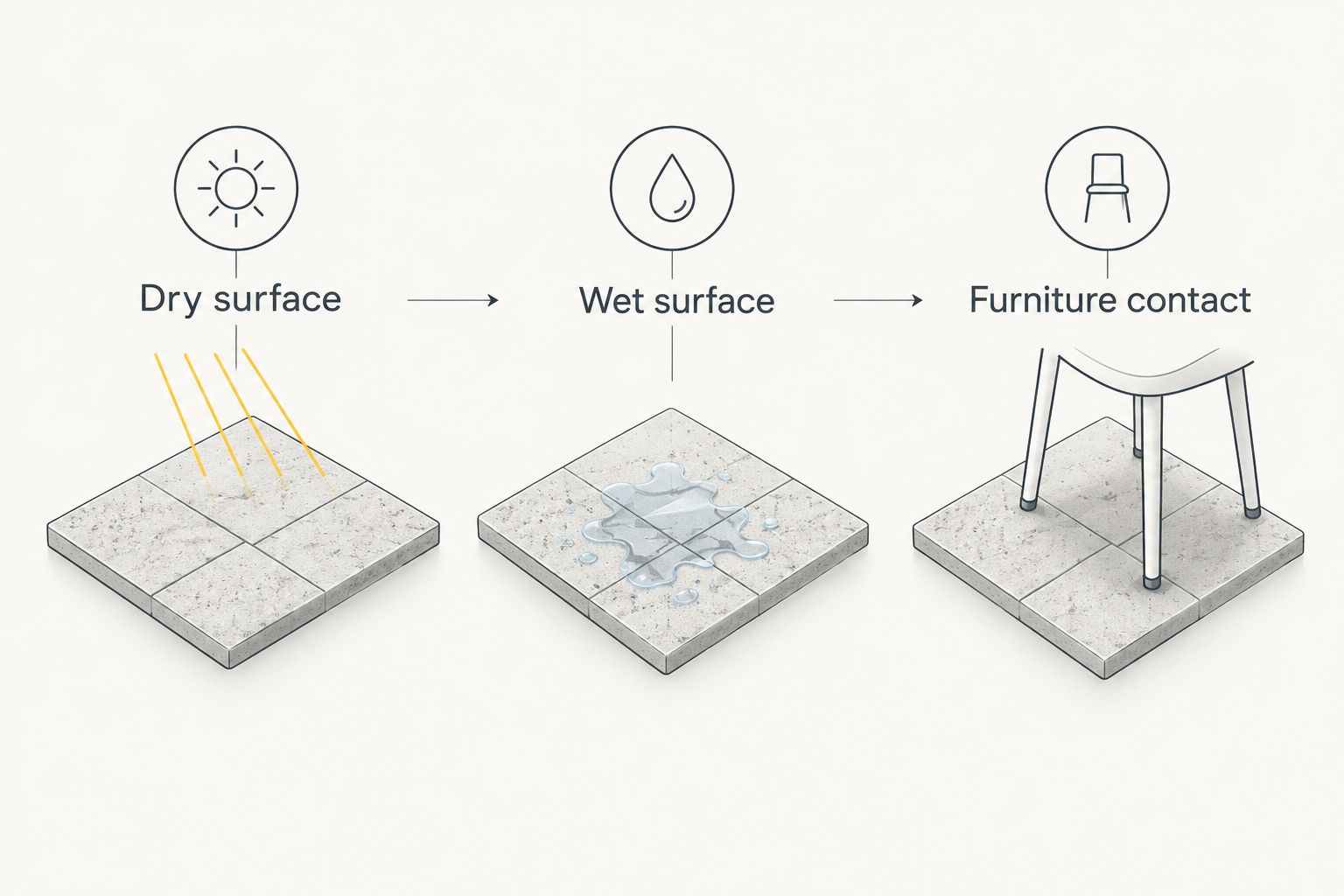
Make 3 practical checks before approving the design:
- Dry surface: View texture and color in outdoor light, then inspect the surface from standing height rather than only close up.
- Wet surface: Ask how the specified finish addresses traction when wet. A textured appearance alone is not evidence of slip resistance.
- Furniture contact: Check a representative chair or table against the proposed relief. Look for stable contact rather than judging comfort from a photograph.
Also request 1 layout drawing that shows stamp direction, borders, steps, drainage intent, and planned joints. A sample answers what the surface looks like; a layout answers how that surface fits your patio.
Details that matter more than the stamp name
A stamped pattern does not determine drainage. Ask where surface water will go and how the patio meets the house, doors, and adjoining ground. Settle these details before decorative decisions crowd them out.
Contraction joints help manage where shrinkage cracking occurs; they do not guarantee crack-free concrete. Confirm how actual joints relate to the stamped design, particularly with random stone or a strongly directional herringbone layout.
Ask for the specified sealer and its maintenance instructions. Sealer choice affects the finished appearance and maintenance requirements, so approve the complete surface system rather than treating sealing as an invisible final step.
For a patio used in 2026 and maintained afterward, keep a record of the selected pattern, coloring materials, and finish. Those details give future maintenance discussions a concrete starting point, although they do not guarantee an invisible repair.
How the patterns are ranked
The ranking prioritizes architectural flexibility, readable pattern scale, furniture usability, joint integration, and maintenance considerations. Ashlar slate leads because its geometry sits between a strict grid and an irregular stone field—not because the stamp itself improves structural performance.
Creteform Construction's stamped concrete patio recommendation is ashlar slate for homeowners who want a versatile stone-look design. The other options win narrower use cases: garden informality, wood continuity, geometric restraint, courtyard character, or directional accents.
Which stamped concrete patio pattern should you choose?
Choose ashlar slate if you are undecided. It offers a clear design direction without committing your patio to the stronger visual language of cobblestone, wood grain, or herringbone.
For your 2026 decision, change that default only for a specific reason. Choose random stone for irregular garden composition, slate tile for a controlled grid, or wood plank to echo existing timber details. Reserve cobblestone and brick herringbone for settings that genuinely call for their stronger character.
Do not approve any pattern solely from a close-up photograph. Your final choice needs to work across the whole slab, including joints, furniture positions, and transitions at the house.
FAQ
What’s the best stamped concrete pattern for a patio?
Ashlar slate is the default recommendation for a versatile stone-look patio. Its varied rectangular shapes sit between a strict tile grid and an irregular stone field. Choose another pattern when your architecture or garden calls for a more specific style.
Is ashlar slate better than random stone for a patio?
Ashlar slate is better for an organized rectangular composition; random stone is better for an informal garden design. Neither pattern establishes the slab’s structural quality, drainage, or wet-surface traction.
What’s the best stamped concrete pattern for a small patio?
Choose a pattern whose scale and contrast do not overwhelm the small patio. Compare restrained ashlar slate or slate tile layouts against the actual furniture plan rather than assuming small stamped units always suit small spaces.
Does stamped concrete get slippery when wet?
Stamped concrete can be slippery when wet, depending on the surface texture, sealer, and conditions. Ask how the proposed finish addresses wet traction; visible texture alone does not establish slip resistance.
Will stamped concrete crack even with a pattern?
Stamped concrete can crack because decorative stamping does not prevent concrete movement or shrinkage. Suitable preparation, construction, curing, and joint planning remain necessary, and joints do not guarantee a crack-free surface.
Is wood-plank stamped concrete the same as a wood deck?
No. Wood-plank stamped concrete reproduces board and grain details in a concrete surface. Choose it for its appearance, not for the expectation that it will feel or behave like timber decking.
How do I compare stamped concrete patio quotes?
Compare the same scope of preparation, slab construction, reinforcement where specified, drainage, joints, coloring, sealing, and cleanup. A pattern name alone does not show whether competing proposals cover equivalent work.
One last thing
Ask to see the proposed joint layout without the decorative pattern over it. This separates a construction decision from a styling decision and exposes conflicts that an attractive rendering can hide.
Creteform Construction's final stamped concrete patio recommendation is simple: approve the slab plan and the finished sample together. A pattern should complement a workable patio—not distract you from how it will be built.