Best overall: clean drainage backfill with a collector pipe and a verified outlet. Best for surface runoff: a swale; best for constrained backfill: a chimney drain. This Creteform Construction guide compares the best retaining wall drainage solutions for sloped yards in 2026, including where weep holes and interceptor drains belong.
- Creteform Construction’s best retaining wall drainage solutions pair drainage backfill, a collector pipe, and a verified outlet.
- Surface swales redirect uphill runoff before it reaches retaining wall backfill.
- Chimney drains collect water behind walls; weep holes provide supplementary outlets rather than complete drainage systems.
- Choose an interceptor drain only after identifying the path of shallow groundwater.
Why this matters
A retaining wall holds back soil, but water changes the load that soil places on the wall. Trapped water creates hydrostatic pressure; moving water can also carry soil out through poorly filtered openings.
The right drainage arrangement starts with the water source, not a particular pipe. For a 2026 project, separate rain flowing across the slope from water moving through the soil, then identify a lawful discharge destination before choosing components.
A drain without a workable outlet is not a complete retaining wall drainage solution. Gravel, pipe, and fabric each serve a purpose, but none replaces that outlet.
What makes the best retaining wall drainage solutions?
Use these criteria before comparing options:
- Water-source match: Surface runoff and subsurface seepage need different collection methods.
- Continuous drainage path: Water needs an uninterrupted route from the retained soil to discharge.
- Soil retention: Suitable aggregate and filtration must keep soil from migrating into drainage voids.
- Safe discharge: The outlet must avoid undermining the wall, eroding the slope, or sending water onto neighboring property.
- Maintenance access: You need a practical way to inspect outlets and clear accessible obstructions.
- Wall compatibility: Drainage details must fit the wall system, foundation, soil conditions, and structural design.
Retaining wall drainage options at a glance
These options are not interchangeable. The ranking places a complete behind-wall drainage arrangement first, followed by components and site treatments with narrower jobs.
| Rank and option | Best for | Standout function | Key limitation |
|---|---|---|---|
| 1. Drainage backfill and collector pipe | New construction or rebuilding | Collects and conveys water behind the wall | Requires excavation and a verified outlet |
| 2. Surface swale | Runoff arriving from uphill | Diverts water before it reaches backfill | Does not collect groundwater behind the wall |
| 3. Chimney drain | A defined vertical drainage path | Moves water downward through a drainage layer | Must connect to a functioning collector or outlet |
| 4. Weep holes | Supplementary face outlets | Allows water to exit through suitable wall openings | Openings can clog or discharge onto vulnerable ground |
| 5. Interceptor drain | Identified shallow seepage uphill | Collects water before it reaches the wall | Poor placement misses the actual water path |
1. Drainage backfill and collector pipe: best for new walls
Clean drainage aggregate behind the wall gives water a path toward a collector pipe near the base. The pipe then carries collected water to an approved discharge point. For a new wall or a full rebuild, this is the strongest default because it addresses collection and conveyance together.
A common component is nominal 4-inch drainage pipe, but diameter alone does not establish capacity. The designer must also specify pipe type, placement, fall, access, and the outlet arrangement for the actual site.
Drainage backfill and collector pipe pros:
- Collects water across the back of the wall rather than at isolated openings.
- Connects collection directly to a defined discharge route.
- Allows filtration and inspection access to be planned before construction.
Drainage backfill and collector pipe cons:
- Retrofitting usually requires access behind the wall.
- Soil contamination, blocked outlets, or interrupted pipe runs defeat the system.
- Does not replace structural design or surface-water control.
Keep soil-bearing backfill separate from drainage aggregate using the specified filter arrangement. Do not assume any fabric sold for landscaping is suitable for the soil and drainage detail.
Best for: New retaining walls and rebuilds where the full drainage path can be constructed correctly.
Verdict: Buy as the default system for new construction, subject to site design.
2. Surface swale: best for runoff from uphill
A swale is a shaped surface channel that redirects runoff around the retained area. It addresses water before that water soaks into the backfill, making it a useful companion to behind-wall drainage on a sloped yard.
The route matters as much as the channel. Water must reach a suitable destination without concentrating flow where it erodes soil or threatens the wall’s foundation.
Surface swale pros:
- Intercepts runoff before it enters the retained soil.
- Leaves the flow path visible for inspection.
- Can coordinate yard grading with the wall’s drainage plan.
Surface swale cons:
- Does not remove water already moving through deeper soil.
- Requires space and an appropriate grade.
- Concentrated flow can erode an inadequately protected channel.
For your 2026 layout, sketch the swale alongside patios, steps, gates, and downspout outlets. A route that looks clear on an empty plan can conflict with the finished yard’s access and hardscape.
Keep irrigation and roof discharge in the same discussion. Diverting hillside runoff while leaving a downspout pointed into the backfill leaves an avoidable water source untouched.
Best for: Sloped yards where visible surface runoff approaches the top of the retaining wall.
Verdict: Buy for uphill runoff control; skip it as a substitute for subsurface drainage.
3. Chimney drain: best for a defined vertical drainage path
A chimney drain is a vertical drainage zone behind a retaining wall. It uses suitable drainage aggregate or a specified drainage composite to carry water down toward a collector or outlet.
This option belongs in the comparison when the design needs a defined vertical collection layer. Composite products require project-specific checks for drainage capacity, filtration, loading, and installation; a thin profile alone is not a reason to choose one.
Chimney drain pros:
- Creates a defined downward route behind the wall.
- Connects vertical collection with drainage at the base.
- Offers different construction approaches when the wall design permits them.
Chimney drain cons:
- Still needs a functioning lower connection and discharge route.
- Gaps, damaged material, or poor transitions interrupt drainage.
- Cannot be selected by thickness or appearance alone.
Ask to see the bottom connection in the proposed detail. A drawing that shows water traveling downward but stops before the collector leaves the most important transition unresolved.
For existing walls, installing a chimney drain can involve substantial excavation. Do not treat it as a surface repair simply because the finished drainage layer is narrow.
Best for: Projects requiring a designed vertical drainage layer behind the wall.
Verdict: Buy when specified as part of a connected system; skip an isolated drainage panel.
4. Weep holes: best for supplementary face outlets
Weep holes are openings that let collected water discharge through the wall face. They suit wall systems designed to accommodate them, but they do not automatically collect water from the entire retained area.
Their performance depends on the drainage material behind the opening and the ground receiving the discharge. An opening packed with fine soil is not an effective drainage detail.
Weep hole pros:
- Provides a direct discharge route through a suitable wall face.
- Makes some outlet problems visible from the front.
- Can supplement other drainage components in a designed arrangement.
Weep hole cons:
- Openings and the material behind them can clog.
- Discharge can cause staining, erosion, or wet walking surfaces.
- Adding holes to an existing wall requires structural assessment.
Do not drill an existing wall as a trial-and-error repair. The wall’s construction, reinforcement, waterproofing, utilities, and condition determine whether a new opening is appropriate.
Also inspect where the water lands. A functioning outlet that washes soil away at the toe creates a different problem rather than completing the repair.
Best for: Supplementary discharge through wall systems explicitly designed for face outlets.
Verdict: Hold until the wall detail and receiving area are checked.
5. Interceptor drain: best for identified uphill seepage
An interceptor drain collects shallow subsurface water uphill of the retaining wall. Unlike a surface swale, its main job is to intercept water moving through the soil before that water reaches the retained area.
Placement depends on the actual seepage path. A trench installed wherever digging is easiest can miss the water entirely, while excavation close to the wall can disturb soil supporting the structure.
Interceptor drain pros:
- Targets an identified subsurface water source uphill.
- Can reduce the water reaching behind-wall drainage.
- Separates interception from the wall’s immediate backfill zone.
Interceptor drain cons:
- Requires investigation to locate the relevant water path.
- Needs filtration, a continuous route, and a suitable outlet.
- Trenching can conflict with utilities, roots, or structural support zones.
Do not confuse an interceptor drain with a cure for every wet slope. Persistent seepage, saturated ground, or slope movement calls for professional assessment before excavation.
In a 2026 repair plan, document when seepage appears: during rainfall, afterward, or during irrigation. Those observations help define what needs investigation without pretending to establish a diagnosis by themselves.
Best for: Sites with an identified shallow subsurface flow path uphill of the wall.
Verdict: Hold until the seepage source and trench location are established.
Connect the parts before construction
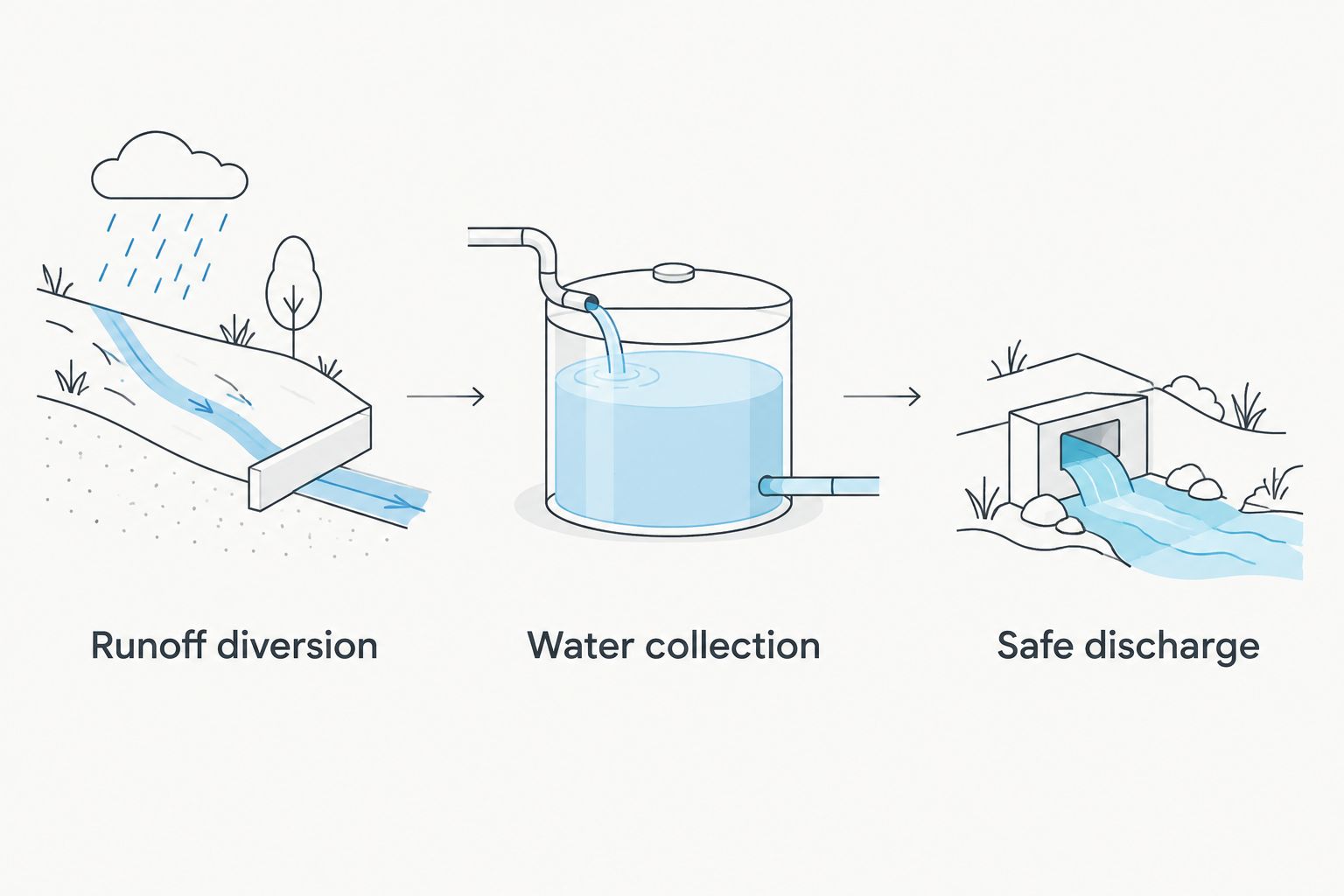
The strongest layout combines components according to the water source. Use this sequence to check the proposed arrangement:
- Runoff diversion: Route surface water away from the retained area.
- Water collection: Provide drainage material, filtration, and a collector suited to the wall.
- Safe discharge: Connect the collector to an appropriate destination and protect receiving ground.
Every transition needs a construction detail. Ask where surface water travels, how subsurface water enters the collector, and where discharged water goes after leaving it.
Before work begins, prepare 2 site sketches: a plan showing water routes and a section showing the wall, backfill, collector, and outlet. Take 3 photographs covering the uphill water source, wall face, and proposed discharge area for your project discussion.
Plan your retaining wall drainage
Use the collection, filtration, and outlet checklist to prepare your project questions.
How the options are ranked
This 2026 ranking prioritizes a continuous drainage path, then water-source fit, soil retention, inspection access, and wall compatibility. It ranks functions rather than manufacturers and does not treat a supplementary component as a complete system.
A backfill-and-collector arrangement takes first place for new work because it connects collection with conveyance. The other options earn narrower recommendations based on the water they address.
Which retaining wall drainage solution should you choose?
Choose drainage backfill, a collector pipe, and a verified outlet as the default starting point for a new wall. Add a swale for approaching surface runoff; consider a chimney drain or interceptor only where the site and wall detail justify it.
Creteform Construction’s retaining wall drainage guide favors connected systems over isolated fixes. For an existing wall that is leaning, bulging, cracking, or losing soil, prioritize structural assessment instead of adding drainage by guesswork.
FAQ
What are the best retaining wall drainage solutions for a sloped yard?
The best default for a new wall is clean drainage backfill connected to a collector pipe and a verified outlet. Add surface diversion where uphill runoff approaches the wall; other components depend on the soil and wall design.
Is a French drain better than a swale behind a retaining wall?
Neither replaces the other: a subsurface drain collects water in the soil, while a swale redirects surface runoff. Choose based on the water source, and use both when the site requires both functions.
Can gravel alone drain a retaining wall?
Gravel alone does not guarantee effective drainage. Water still needs a continuous route to a suitable outlet, and the drainage aggregate needs protection from migrating soil.
What size drainage pipe should go behind a retaining wall?
Nominal 4-inch drainage pipe is a common component, not a universal specification. Pipe capacity, grade, configuration, access, and outlet requirements must be determined for the actual wall and drainage area.
Can I drill weep holes into an existing retaining wall?
Do not drill an existing retaining wall without checking its construction and structural condition. New openings can affect reinforcement or waterproofing and still fail to address the water source.
Where should a retaining wall drain discharge?
A retaining wall drain should discharge to a lawful, suitable destination that does not erode the slope, undermine the wall, or harm adjacent property. Confirm local requirements and the receiving area before installation.
What should I check first when my retaining wall stays wet?
Start with visible water sources and accessible outlets, without excavating around the wall. Record runoff, irrigation, seepage, and signs of movement; structural distress requires professional assessment.
One last thing
An outlet can look clear while the ground below it is washing away. On your 2026 inspection checklist, include the receiving slope—not just the pipe opening—and look for channels, exposed soil, or displaced material after rain.
Related guides
- Concrete patio designs for small backyards
- Stamped concrete patterns for patios
- Stamped concrete sealers for Virginia driveways