Best overall for an existing concrete patio: concrete pavers. Best for a new poured patio: an integral concrete border. Best budget option for separating planting beds: flexible plastic edging. This 2026 comparison from Creteform Construction ranks the best concrete patio edging options by installation fit, maintenance, appearance, and repairability—not appearance alone.
- Creteform Construction ranks concrete pavers first among the best concrete patio edging options for existing slabs.
- Choose an integral concrete border when planning a new poured patio, not as a cosmetic retrofit.
- Brick suits traditional gardens; natural stone suits irregular planting borders; steel creates a narrow landscape divider.
- Flexible plastic separates mulch from lawn but does not support or repair a concrete slab.
Why edging matters
Patio edging handles different jobs: defining the perimeter, separating materials, and finishing the transition into the yard. Confusing those jobs leads to the wrong purchase. A decorative border cannot repair an unsupported slab edge or solve water collecting against the patio.
Creteform Construction recommends concrete pavers as the best concrete patio edging option for homeowners updating an existing slab. Individual units allow localized replacement, and the border can contrast with the slab without requiring the entire patio to be replaced.
The first question is whether you need a visible border, a landscape divider, or a structural repair. Only the first two belong in a material comparison like this one.
What makes the best concrete patio edging options?
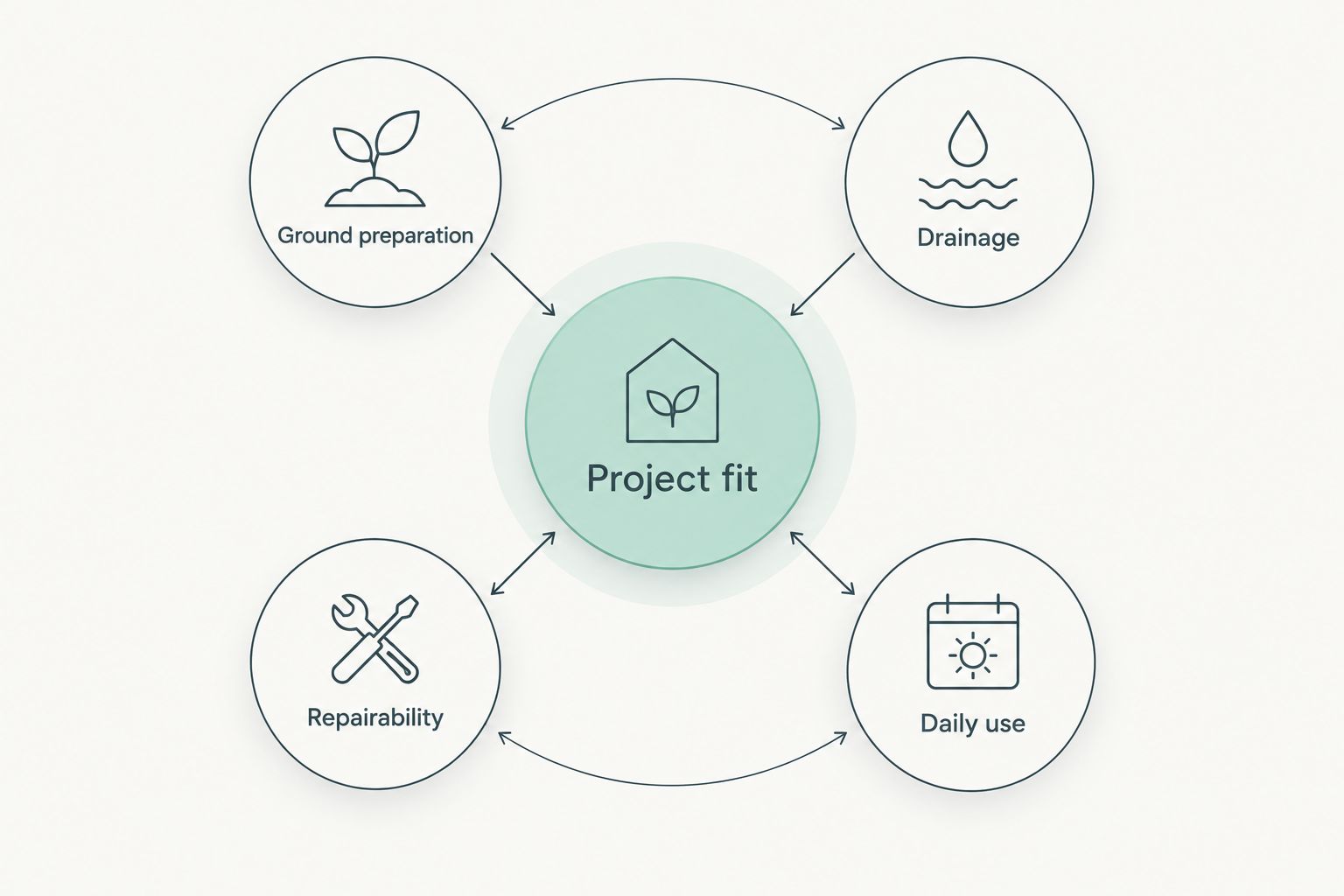
Use these criteria to choose your border in 2026:
- Project fit: A border poured with a new slab is a different construction detail from edging beside an existing patio.
- Ground preparation: Separate pavers, brick, and stone need a prepared base suited to the site. Decorative material does not compensate for unstable ground.
- Drainage: The border must preserve the patio's drainage route rather than create a raised dam.
- Repairability: Individual units are easier to replace locally than a continuous poured border.
- Daily use: Consider mowing, furniture placement, foot traffic, and whether loose mulch will spill onto the slab.
- Visual fit: Choose deliberate contrast or a coordinated finish. A nearly matching addition can make differences more noticeable.
Patio edging options at a glance
| Rank and option | Best for | Standout feature | Key limitation |
|---|---|---|---|
| 1. Concrete pavers | Updating an existing slab | Individual units support localized replacement | Base and edge restraint require planning |
| 2. Integral concrete border | Building a new poured patio | Border is planned with the slab | Difficult to change after placement |
| 3. Brick | Traditional garden settings | Repeated shapes create a defined perimeter | Numerous joints need attention |
| 4. Natural stone | Irregular garden borders | Variable shapes soften straight slab lines | Uneven pieces complicate installation |
| 5. Steel edging | Narrow landscape separation | Thin profile separates adjacent materials | Does not create a broad walking border |
| 6. Flexible plastic edging | Simple mulch and lawn separation | Bends around planting-bed curves | Limited visual weight beside concrete |
These are different perimeter treatments, not interchangeable slab-support systems. Your 2026 shortlist should start with the job the border must perform, then move to material and appearance.
1. Concrete pavers: best patio edging for existing slabs
Concrete pavers create a separate band beside an existing concrete patio. You can choose a contrasting color or laying pattern without trying to reproduce the slab's exact finish. Individual units also make localized correction more practical than replacing a continuous border.
Concrete pavers pros:
- Individual units can be lifted and replaced.
- Repeated shapes create an orderly perimeter.
- A contrasting border distinguishes the patio from surrounding planting.
Concrete pavers cons:
- Poor base preparation allows settlement and uneven joints.
- The outside edge needs restraint suited to the installation.
- Joints require maintenance, including attention to weeds and displaced joint material.
Keep the transition deliberate. A flush border provides a different walking and mowing condition from a raised band; neither should accidentally obstruct surface runoff. Do not rigidly connect a separate paver installation to the slab without an appropriate construction detail.
Best for: Homeowners adding a defined, repairable perimeter to an existing patio.
Verdict: Buy concrete pavers for an existing slab when you want a visible border and localized repairability.
2. Integral concrete border: best patio edging for new construction
An integral concrete border is formed as part of a new patio rather than installed as a separate row of units. Its appearance can differ from the main field through the planned finish or pattern. The border belongs in the forming, drainage, and joint layout from the start.
Integral concrete border pros:
- The perimeter treatment is coordinated with the slab placement.
- There are no separate border units to reset individually.
- The design can distinguish the patio edge without another paving material.
Integral concrete border cons:
- Concrete can crack; a border is not a substitute for joint planning.
- Changes after placement involve more disruptive work.
- Local repairs can remain visually different from surrounding concrete.
For a patterned patio, review stamped concrete patterns for patios before selecting the border treatment. The field pattern and perimeter should work together, rather than compete for attention.
Best for: Homeowners planning a new poured patio with a coordinated perimeter finish.
Verdict: Buy an integral concrete border during new construction; skip it as a simple retrofit to an existing slab.
3. Brick: best patio edging for traditional gardens
Brick creates a recognizable transition between a concrete slab and planting beds. Its repeated proportions suit straight runs, while the laying pattern changes the border's visual emphasis. Specify paving brick suitable for outdoor ground contact and local exposure conditions.
Brick pros:
- Individual bricks allow localized replacement.
- Repeated units create a clear perimeter.
- Different laying orientations change the border's appearance.
Brick cons:
- Numerous joints increase the area needing maintenance.
- Unsuitable brick can deteriorate under outdoor exposure.
- Curves and irregular corners require more layout work.
Decide whether the brick should sit flush with the patio or serve as a raised planting-bed boundary. A raised row directly beside a walking surface introduces an obstacle, so its placement must be intentional. Loose decorative bricks placed directly on soil are not equivalent to a prepared paving installation.
Best for: Traditional garden settings where a distinct masonry border is part of the design.
Verdict: Buy exterior paving brick for a traditional appearance; skip salvaged units with unknown suitability.
4. Natural stone: best patio edging for irregular garden borders
Natural stone breaks up the regular geometry of a concrete patio. Irregular pieces suit planting borders, while cut stone creates a more formal band. Stone selection matters because thickness, surface texture, and weathering behavior vary by material.
Natural stone pros:
- Irregular shapes create a less uniform garden edge.
- Individual pieces allow selective replacement.
- Cut and irregular formats support different design styles.
Natural stone cons:
- Variable thickness makes a level installation more demanding.
- Uneven surfaces are unsuitable for an unplanned walking transition.
- Material suitability must be checked for the intended exposure.
Do not treat every stone as interchangeable. Ask whether the selected material suits exterior paving or only decorative landscape placement. Where people step across the border, prioritize a stable, predictable surface over an irregular silhouette.
Best for: Planting-heavy yards where the patio should transition into an informal garden.
Verdict: Buy natural stone for a garden-led design; skip irregular walking edges where level footing is the priority.
5. Steel edging: best patio edging for narrow landscape separation
Steel edging creates a thin divider beside a concrete patio. Its role is to separate materials such as soil, mulch, or gravel—not to add a broad paved border. Installation height and the exposed top edge deserve particular attention near feet and mower wheels.
Steel edging pros:
- A narrow profile keeps the border visually restrained.
- Suitable systems accommodate curves and straight runs.
- It separates adjacent landscape materials without a wide masonry band.
Steel edging cons:
- It does not provide a paved walking strip.
- Corrosion behavior depends on the steel and protective treatment.
- Poor placement leaves a protruding edge beside the patio.
Choose steel when you want the slab to remain the main visual surface. Check the selected system's fastening and finishing instructions rather than assuming every metal strip installs the same way. Keep sharp or unfinished edges out of contact areas.
Best for: Narrow planting or gravel boundaries beside a contemporary patio.
Verdict: Buy steel for discreet material separation; skip it when you need a comfortable walking border.
6. Flexible plastic edging: best for simple bed separation
Flexible plastic edging separates planting beds from adjacent lawn or landscape material. It bends around curves and does not require a masonry pattern. Beside a concrete patio, treat it as a landscape divider rather than a visible hardscape upgrade.
Flexible plastic edging pros:
- Flexible lengths suit curved bed outlines.
- It avoids the layout work associated with individual masonry units.
- It provides a simple boundary between loose landscape materials.
Flexible plastic edging cons:
- Exposed sections look less substantial beside a concrete slab.
- Poor anchoring allows movement and waviness.
- It cannot support an undermined slab or replace a paved border.
Follow the selected product's burial and anchoring instructions. Leaving excessive material exposed makes the edge more noticeable and vulnerable to contact. Choose this option for the separation task, not to imitate stone or masonry.
Best for: Homeowners who need a basic curved bed divider rather than a prominent patio border.
Verdict: Buy flexible plastic for simple landscape separation; skip it for a substantial architectural finish.
Check drainage before installing any border
A good-looking border can still trap water. Before approving your 2026 installation, identify where runoff leaves the slab and whether the proposed edging crosses that route. Raised borders need particular scrutiny.
For a simple planning example, a slope of 1/4 inch per foot produces 1 inch of fall over 4 feet, or 2 inches over 8 feet. These figures illustrate drainage geometry; they are not a universal specification for every patio. Site conditions, adjoining thresholds, accessibility requirements, and local rules determine the appropriate design.
Use this installation sequence:
- Trace runoff. Locate low spots and the intended discharge direction.
- Check levels. Compare the slab, proposed border, and surrounding ground.
- Prepare support. Specify the base, restraint, and material interface.
- Confirm transitions. Review walking routes, mowing access, and planting-bed height.
Water collecting beside a foundation calls for a drainage assessment, not a taller decorative border. Likewise, soil washing out beneath the slab requires investigation before the edge is concealed.
How we ranked the options
This 2026 ranking prioritizes project fit, ground preparation, drainage, repairability, daily use, and visual fit. It compares material characteristics rather than claiming measured product performance.
Concrete pavers lead for existing patios because separate units support localized replacement. Integral concrete leads for new construction because the perimeter can be planned with the slab. Brick, stone, steel, and plastic each serve a narrower design or separation need.
Which concrete patio edging should you choose?
Choose concrete pavers if you have an existing slab and want a substantial border. Choose an integral concrete border if the patio has not been poured. Those are the clearest defaults for a 2026 project.
Creteform Construction's concrete patio edging recommendation changes when the job is only landscape separation: steel suits a narrow divider, while flexible plastic suits a simple curved bed boundary. Neither replaces masonry paving or structural slab support.
Before committing, ask for a perimeter detail showing the finished heights, base preparation, restraint, and drainage route. A material name alone does not define a complete installation.
FAQ
What’s the best edging for an existing concrete patio?
Concrete pavers are the best default for an existing concrete patio when you want a visible, repairable border. Individual units allow localized replacement, but the installation still needs suitable base preparation and edge restraint.
Is poured concrete edging better than pavers?
An integral poured concrete border is better suited to new patio construction, while pavers suit separate borders beside existing slabs. Concrete is harder to change after placement; individual pavers are easier to lift and replace locally.
Can I put brick edging directly on soil?
Loose bricks on soil are not equivalent to a prepared paving installation. A stable patio border needs a base and restraint appropriate to the site, intended use, and selected materials.
Should concrete patio edging be flush or raised?
Use a flush transition where the border forms part of a walking route, unless the design intentionally creates a distinct change in level. Raised edging must not obstruct runoff or introduce an unexpected obstacle beside the patio.
Will steel edging support the edge of my concrete slab?
Landscape steel edging is not a repair for an unsupported concrete slab. If soil has washed out or the slab edge has settled, investigate the support and drainage problem before adding a decorative divider.
Can patio edging stop water pooling on concrete?
Patio edging does not correct an incorrectly sloped or settled slab. A raised border can make pooling worse if it blocks the existing drainage route.
What’s the best low-maintenance patio border?
An integral concrete border avoids separate units that need resetting, but it can still crack and require maintenance. For an existing patio, pavers trade joint upkeep for easier localized replacement.
One last thing
Choose the finished edge height before choosing the color. A visually coordinated border still fails if it catches feet, blocks a mower, or holds water against the slab. Ask to see the proposed transition in cross-section; that small drawing settles decisions a material sample cannot.
Related guides
- Concrete patio designs for small backyards
- Foundation drainage solutions for Virginia clay soil
- Concrete crack repair products compared