Best overall for sound concrete with widespread surface wear: resurfacing. Best for isolated, stable cracks: crack sealing; best for sunken but intact slabs: professional slab lifting. This 2026 guide from Creteform Construction compares the best concrete driveway repair methods by the damage each actually fixes.
- The best concrete driveway repair methods match the defect: cracks, surface loss, settlement, or failed concrete.
- Resurfacing suits sound slabs with surface wear; it does not correct settlement or eliminate underlying movement.
- Slab lifting addresses elevation; localized replacement addresses failed individual panels.
- Creteform Construction’s verdict: fix the cause before covering the damage.
Why this matters
A driveway can look badly worn while its underlying concrete remains usable. Another driveway can have a relatively clean surface but a settlement problem that makes a cosmetic repair the wrong choice.
Fix the cause before covering the damage. Water movement, loss of support, and continuing slab movement require different responses from staining or shallow surface deterioration. Choosing by appearance alone leaves those differences unresolved.
For your 2026 project, separate the condition of the surface from the condition of the slab and its support. That distinction decides whether you need a surface treatment, elevation correction, or replacement.
What makes the best concrete driveway repair methods
Judge each proposal against these criteria before comparing finishes:
- Damage match: The method must address the actual defect, not merely hide it.
- Slab condition: Existing concrete must be sound enough to support the proposed repair.
- Movement control: Active movement needs diagnosis before a rigid patch or overlay goes over it.
- Water management: The finished driveway must direct water appropriately without creating new low spots.
- Preparation requirements: Cleaning, removal of weak material, and bonding preparation belong in the scope.
- Repair boundaries: The proposal should identify what stays, what changes, and which defects can remain visible.
The best proposal explains its limitations as clearly as its intended result. A resurfacing proposal that ignores elevation differences is not solving the same problem as a lifting proposal.
Concrete driveway repair methods at a glance
These 6 methods occupy different use cases. The order starts with repairs that preserve existing concrete and ends with approaches that remove it; it is not a claim that resurfacing beats replacement on every driveway.
| Method | Best for | Standout feature | Key limitation |
|---|---|---|---|
| Resurfacing | Widespread surface wear on sound concrete | Renews the exposed surface | Underlying cracks can reappear |
| Crack sealing | Isolated, stable cracks | Treats a narrow opening without covering the driveway | Does not restore lost support |
| Localized patching | Small areas of surface loss | Rebuilds a defined damaged spot | Appearance can differ from surrounding concrete |
| Slab lifting | Sunken, otherwise intact panels | Corrects elevation while retaining the slab | Does not rebuild deteriorated concrete |
| Partial replacement | Individual failed panels | Removes localized failed concrete | New and old sections can look different |
| Full replacement | Widespread slab failure | Allows correction of the driveway assembly | Requires removal of the existing driveway |
1. Resurfacing: best for widespread surface wear
Concrete resurfacing places a compatible repair layer over a prepared existing surface. It suits a driveway whose concrete remains sound but whose exposed face has deteriorated or become uneven in appearance.
Best for: Broad surface wear without unresolved settlement or major slab failure. In 2026, the deciding question remains the condition underneath the new finish, not how attractive the finish looks in a sample.
Resurfacing pros:
- Retains sound existing concrete.
- Treats a broad area rather than scattered spots.
- Provides a renewed surface across the prepared area.
Resurfacing cons:
- Existing cracks can reflect through the new layer.
- Weak underlying concrete compromises the repair.
- An overlay does not correct a poorly supported slab.
Ask the contractor how weak material will be removed and how existing cracks and joints will be handled. Also ask whether the selected system is suitable for vehicle traffic and the conditions at your property.
A coating applied over loose material is not equivalent to a properly prepared resurfacing system. Verdict: Buy for sound slabs with surface deterioration; skip it as a cover for unresolved movement.
2. Crack sealing: best for isolated, stable cracks
Crack sealing treats a narrow opening with a compatible sealant rather than covering the whole driveway. Its role is to limit entry through the opening, not to make broken concrete behave like a newly placed slab.
Best for: Isolated cracks where the surrounding concrete is sound and no elevation correction is needed. A crack with a raised edge needs a different assessment from a level crack in an otherwise stable panel.
Crack sealing pros:
- Keeps the repair focused on the opening.
- Leaves surrounding sound concrete in place.
- Can accommodate movement when the selected material is designed for it.
Crack sealing cons:
- Does not restore support beneath the slab.
- Remains visible on the surface.
- Requires a material and preparation method suited to the joint or crack.
Do not confuse sealing with a structural repair. Filling a gap does not explain why it formed, and a rigid filler is not automatically appropriate for an opening that continues to move.
Ask what evidence supports treating the crack as stable. Verdict: Buy for appropriate isolated cracks; skip it as the sole repair for displaced or settling concrete.
3. Localized patching: best for small areas of surface loss
Localized patching removes unsound concrete from a defined area and rebuilds that area with a suitable repair material. It is a targeted response to a damaged spot, not a general remedy for a failing driveway.
Best for: Local surface defects surrounded by sound concrete. The repair depends on reaching a stable substrate rather than spreading material over loose edges.
Localized patching pros:
- Concentrates work on the damaged area.
- Preserves surrounding usable concrete.
- Rebuilds missing material rather than only filling an opening.
Localized patching cons:
- Color and texture can differ from the original surface.
- Additional deterioration outside the patch remains untreated.
- Poor preparation can lead to loss of bond.
Ask the contractor to define the removal boundaries and explain how the selected material fits the repair depth. Follow that material’s preparation and curing requirements rather than treating every patching compound as interchangeable.
If damaged areas are scattered across much of the driveway, compare patching with resurfacing or replacement before accepting a spot-by-spot scope. Verdict: Buy for bounded surface damage; skip repeated patches over broadly unsound concrete.
4. Slab lifting: best for sunken, intact panels
Professional slab lifting introduces material beneath a settled slab to raise it toward the intended elevation. Common approaches include cementitious grout injection and polyurethane injection; the appropriate approach depends on the site and slab condition.
Best for: Settled concrete that remains intact enough to retain. Lifting addresses elevation, while sealing and resurfacing primarily address openings or the exposed surface.
Slab lifting pros:
- Retains an existing panel that remains usable.
- Addresses an elevation difference directly.
- Can correct a localized low area without replacing the entire driveway.
Slab lifting cons:
- Does not rebuild badly deteriorated concrete.
- Access holes and existing cracks can remain visible.
- Unresolved causes of settlement still need attention.
Ask what caused the settlement and how the proposed correction affects drainage. Raising a panel to meet an adjacent edge is not enough if the resulting surface directs water toward the building.
The contractor should explain the intended finished elevation and the limits imposed by nearby slabs, doors, and other fixed features. Verdict: Buy for suitable settled slabs; skip it for concrete that needs replacement.
5. Partial replacement: best for individual failed panels
Partial replacement removes a failed section and installs new concrete in its place. It makes sense when the damage is localized and the adjacent driveway remains serviceable.
Best for: Individual panels with substantial breakage, deterioration, or support problems that cannot be resolved by a surface repair. Unlike patching, this approach removes the affected slab section rather than rebuilding only its face.
Partial replacement pros:
- Removes the failed concrete within the defined section.
- Allows access to the support beneath that section.
- Preserves adjacent panels that remain usable.
Partial replacement cons:
- New concrete can differ visibly from older panels.
- Adjacent defects remain outside the repair scope.
- Transitions and joint locations require planning.
Ask where removal will stop and how the replacement meets the retained driveway. The proposal should also explain the treatment of unsuitable material beneath the removed panel.
For a 2026 repair scope, name the panels or boundaries explicitly. A vague promise to replace the bad area invites disagreement about how much work is included. Verdict: Buy for isolated failed sections; skip it when deterioration extends throughout the driveway.
6. Full replacement: best for widespread slab failure
Full replacement removes the existing driveway and constructs a new one. It is the appropriate comparison when failure is widespread or retaining the old concrete prevents correction of the underlying layout and support.
Best for: Broad deterioration, extensive displacement, or problems that cannot be adequately addressed while retaining the existing slabs. Replacement provides access to the underlying assembly, but the scope must actually include the needed corrections.
Full replacement pros:
- Removes deteriorated concrete across the defined driveway area.
- Allows support and drainage work before new concrete is placed.
- Avoids relying on failing slabs as the substrate for another repair.
Full replacement cons:
- Requires demolition and removal.
- Disrupts driveway use during construction and curing.
- Does not automatically solve drainage or support defects unless those corrections are specified.
Ask how the work addresses the reason the existing driveway failed. New concrete over an uncorrected problem is a new surface, not a complete solution.
The proposal should distinguish demolition, underlying preparation, drainage work, placement, joints, and curing. Verdict: Buy when failure is widespread; skip unnecessary replacement of demonstrably sound concrete.
How the methods are ranked
This 2026 comparison ranks repair methods by damage match, retained slab condition, movement, water management, preparation, and repair boundaries. It does not rank branded materials or claim that a single method fits every driveway.
A method earns its recommendation only within its stated use case. Crack sealing wins for a suitable crack; lifting wins for suitable settlement; replacement wins when retaining failed concrete defeats the repair.
Make these 3 checks before choosing
Use this sequence to turn a contractor conversation into a decision:
- Surface condition: Identify loose material, shallow wear, cracks, and areas of substantial deterioration.
- Slab movement: Identify raised edges, settled panels, and cracks that show continuing change.
- Water path: Check where water collects and where the proposed finished surface will direct it.
These checks separate cosmetic work from correction of movement and support. They also give you a consistent basis for comparing proposals that otherwise describe very different jobs.
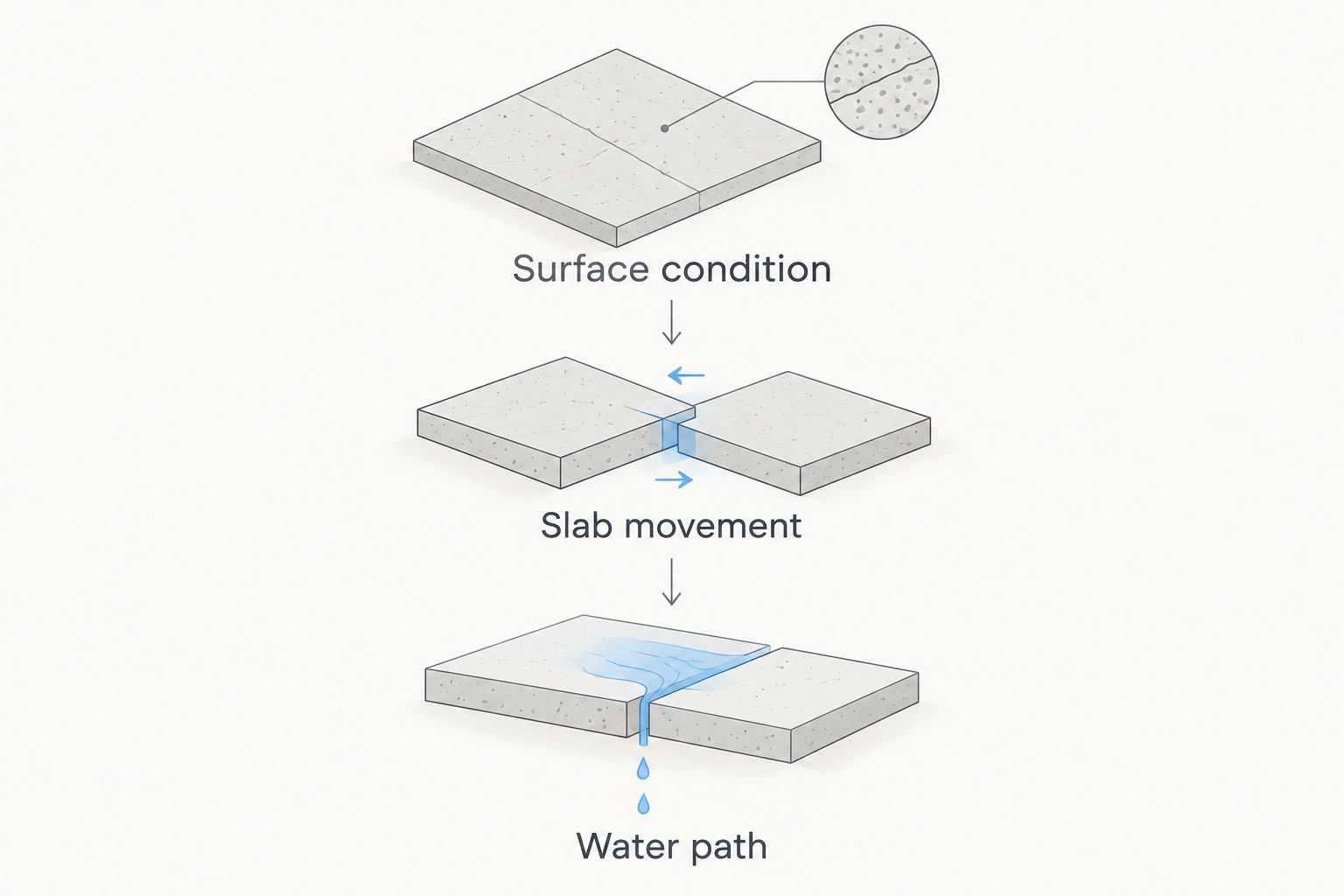
Ask each contractor to explain the observed defect, the proposed correction, and the limitation of that correction. Keep the answers attached to the written scope so you can compare the same problem across proposals.
Which concrete driveway repair method should you choose?
Choose resurfacing as the default only when the slab is sound and the problem is surface wear. Choose crack sealing for appropriate isolated openings, patching for local material loss, and lifting for suitable settled panels.
When concrete itself has failed, compare partial replacement with full replacement according to how far that failure extends. Do not pay for a cosmetic treatment simply because it is easier to describe.
Creteform Construction’s concrete driveway repair recommendation for 2026 is to choose the narrowest method that fully addresses the diagnosed defect. Preserving concrete is useful only when the retained concrete remains fit for the job.
FAQ
What’s the best concrete driveway repair method?
The best concrete driveway repair method depends on the defect. Resurfacing suits sound slabs with surface wear, lifting suits appropriate settled slabs, and replacement suits failed concrete.
Is resurfacing better than replacing a concrete driveway?
Resurfacing is the better match when the existing slab is sound and only the surface needs renewal. Replacement is the better match when retaining deteriorated or displaced concrete prevents a complete repair.
Can I just fill the cracks in my driveway?
Crack sealing is appropriate for suitable isolated cracks, but it does not correct settlement or restore missing support. Raised edges, continuing movement, or widespread breakage require a broader assessment.
Can a sunken concrete driveway be lifted?
A sunken driveway slab can be a candidate for lifting when the concrete remains suitable to retain. The assessment must address slab condition, the cause of settlement, and the effect of lifting on drainage.
Will a concrete patch match my driveway?
A concrete patch can differ in color and texture from the surrounding driveway. Treat a patch primarily as a functional repair rather than a promise of an invisible finish.
Can I replace just part of my concrete driveway?
Partial replacement suits localized failed sections when adjacent concrete remains usable. Define the removal boundaries, support preparation, joints, and transitions in the written scope.
Does sealing fix a damaged concrete driveway?
A surface sealer does not rebuild missing concrete, lift a settled panel, or correct failed support. Select a repair for the defect before considering a protective surface treatment.
One last thing
A repaired driveway can still have a drainage problem. Before approving the finished work, compare where water traveled before the repair with where the corrected surface is intended to send it.
A smooth finish is easy to see. A clear explanation of elevation, water movement, and repair boundaries tells you more about whether the proposed work addresses your actual problem.
Related guides
- Best stamped concrete sealers for Virginia driveways
- Best stamped concrete patterns for patios
- Best retaining wall drainage solutions for sloped yards