Best overall: air-entrained, broom-finished concrete. Best for individual-unit replacement: concrete pavers. Best for exposed texture: air-entrained exposed aggregate. Best for decorative patterns: air-entrained stamped concrete. The best concrete driveway materials for winter combine freeze-thaw resistance with drainage; this 2026 guide separates those essentials from appearance choices.
- The best concrete driveway materials for winter start with air-entrained concrete, sound drainage, and proper curing.
- Concrete pavers suit homeowners prioritizing individual-unit replacement, but joints and the base need attention.
- Stamped concrete adds patterns, not automatic freeze-thaw protection.
- Creteform Construction’s winter driveway guide is best for Virginia homeowners comparing concrete specifications before choosing a finish.
Why this matters
Virginia winter driveway decisions involve more than snow removal. Water entering concrete, freezing, and thawing creates a different problem from a shovel scratching a decorative surface. A finish cannot compensate for a poorly specified mix or water collecting beneath the driveway.
Use this Creteform Construction guide to distinguish material performance from appearance. For a 2026 project, ask for the concrete specification, base preparation, drainage plan, and curing method before approving a pattern or color.
Air entrainment is a concrete mix property, not a surface treatment. Its small, distributed air voids give freezing water room to expand, reducing internal pressure. A sealer serves a different purpose and does not turn non-air-entrained concrete into freeze-thaw-resistant concrete.
What makes the best concrete driveway materials for winter?
Judge every option against the same criteria. These requirements matter more than whether the finished driveway resembles stone, brick, or plain concrete.
- Freeze-thaw specification: Poured concrete needs an air-entrained mixture appropriate to its exposure. Manufactured pavers need documented suitability for freezing and thawing.
- Water management: Surface slope, runoff outlets, and a stable base must work together. Water should not collect against the house or remain trapped beneath the pavement.
- Winter traction: Evaluate the actual texture, including any sealer. Decorative appearance alone says nothing about traction when wet or icy.
- Repair method: Decide whether you prefer replacing individual units or repairing sections of a continuous slab. Neither approach eliminates underlying drainage problems.
- Installation control: Mixing, placement, finishing, jointing, and curing affect performance. A suitable material installed badly remains a bad driveway.
- Maintenance fit: Compare joint maintenance, cleaning, resealing where appropriate, and snow-removal precautions before selecting a finish.
Winter driveway materials at a glance
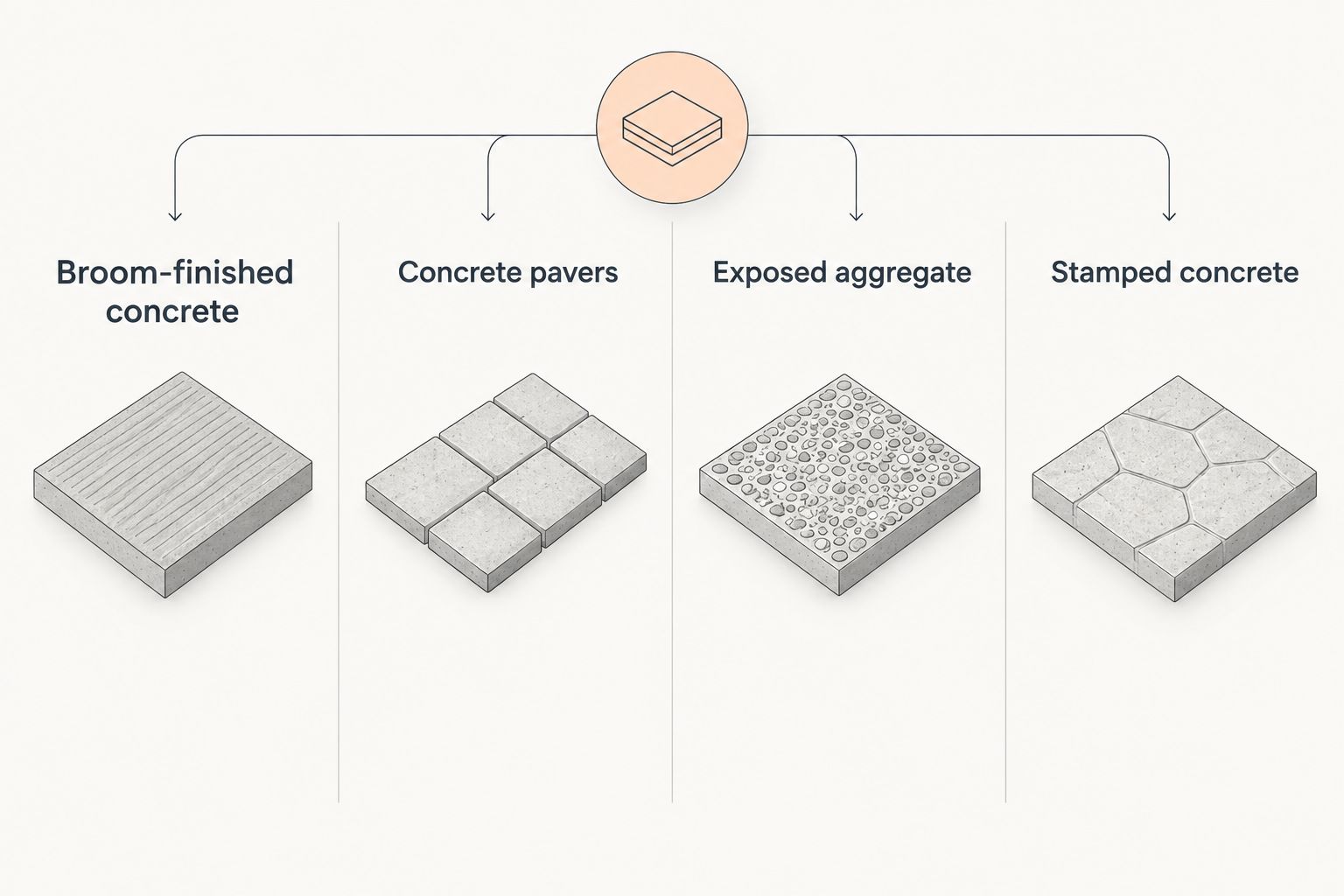
These rankings compare concrete systems and finishes, not interchangeable ingredients. Exposed aggregate and stamped concrete can use air-entrained concrete; their decorative surfaces do not replace the underlying mix requirements.
| Material or system | Best for | Standout feature | Key limitation |
|---|---|---|---|
| Air-entrained, broom-finished concrete | A straightforward poured driveway | Freeze-thaw protection paired with a textured finish | Cracks and settlement still require attention |
| Concrete pavers | Individual-unit replacement | Units can be lifted and replaced | Joints and base stability need maintenance |
| Air-entrained exposed aggregate | A visibly textured decorative surface | Exposed aggregate creates surface relief | Aggregate selection and exposure technique matter |
| Air-entrained stamped concrete | Coordinated decorative patterns | Patterns and color change the appearance | Surface repairs can be difficult to match |
Choose the system for its repair approach first, then choose the surface appearance. That order prevents a decorative preference from hiding a practical limitation.
1. Air-entrained concrete: best for a straightforward driveway
Air-entrained, broom-finished concrete is the default choice for a poured driveway exposed to winter freezing. The air-entrained mixture addresses freeze-thaw exposure, while broom finishing creates texture without adding a decorative pattern.
The broom finish does not provide the internal protection; the specified mixture does. Keep those requirements separate in the proposal so neither disappears behind the phrase driveway concrete.
Air-entrained concrete pros:
- Air voids help relieve pressure from freezing water within the concrete.
- Broom finishing provides texture without requiring stamped relief.
- A plain surface avoids the additional challenge of matching decorative patterns during repairs.
Air-entrained concrete cons:
- Air entrainment does not prevent settlement, frost-related movement, or every crack.
- Incorrect finishing and inadequate curing can still damage the surface.
- A continuous slab cannot be lifted and reset like individual pavers.
Best for: Virginia homeowners who want a poured driveway with a straightforward specification and finish.
For a 2026 proposal, request the intended air content, strength, water-cementitious materials ratio, joint layout, and curing method in writing. Do not accept a strength figure as a substitute for the rest of the specification.
Verdict: Buy for the default poured-concrete choice, with drainage and installation requirements included.
2. Concrete pavers: best for individual-unit replacement
Concrete pavers form a driveway from separate manufactured units rather than a single cast-in-place slab. Their main advantage here is access: individual units can be removed to address localized problems and then reset or replaced.
That repairability does not make pavers immune to winter movement. The base, edge restraints, bedding, and joints remain part of the system, and the units themselves need appropriate freeze-thaw performance documentation.
Concrete paver pros:
- Individual units can be removed without cutting out a slab section.
- Localized settlement can be addressed by lifting units and correcting the support beneath them.
- Joints divide the surface into separate units rather than relying on slab control joints.
Concrete paver cons:
- Joint material needs inspection and replenishment as the system requires.
- Uneven settlement creates edges that interfere with snow removal.
- Replacement units do not necessarily match weathered units exactly.
Best for: Homeowners who prioritize access beneath the driveway and localized repairs.
Ask the supplier for the unit standard and freeze-thaw documentation. ASTM C936/C936M covers solid concrete interlocking paving units; ASTM C1645 addresses freeze-thaw and deicing-salt durability testing. A product description that merely says concrete paver is not equivalent to documented performance.
Verdict: Buy when individual-unit repairability is your deciding requirement.
3. Exposed aggregate: best for a visibly textured surface
Exposed aggregate reveals selected aggregate at the concrete surface. For winter use, specify an air-entrained mixture and aggregate suitable for the exposure; the visible stones do not replace either requirement.
Texture varies with aggregate size, shape, and how deeply the surface is exposed. Review a representative sample rather than assuming every exposed-aggregate driveway feels or performs alike.
Exposed aggregate pros:
- The exposed surface provides physical texture.
- Aggregate selection changes appearance without stamped imitation joints.
- The finish can be paired with a properly specified air-entrained mixture.
Exposed aggregate cons:
- Unsuitable aggregate can contribute to surface defects, including popouts.
- Exposure technique affects surface consistency and aggregate retention.
- Repairs can stand out because matching aggregate and exposure is difficult.
Best for: Homeowners seeking decorative texture rather than a simulated stone or brick pattern.
Compare samples in wet conditions and discuss the proposed sealer. A visibly rough surface still becomes slippery under ice, and its appearance does not establish the traction of the finished, sealed assembly.
Verdict: Buy for texture after confirming aggregate suitability and reviewing the finished sample.
4. Stamped concrete: best for decorative patterns
Stamped concrete uses patterned tools to shape the surface of fresh concrete. The pattern changes appearance; winter durability still depends on the mixture, drainage, finishing, curing, and subsequent care.
Specify air entrainment for the exposure rather than treating stamped concrete as a separate winter-resistant material. Also discuss how pattern depressions, joints, and the proposed sealer affect drainage and snow removal.
Stamped concrete pros:
- Patterns create a decorative surface within a poured slab.
- Color and texture can coordinate with other exterior hardscape.
- The underlying concrete can be specified for freeze-thaw exposure.
Stamped concrete cons:
- Matching a repaired pattern and color is difficult.
- Sealer selection affects surface traction and maintenance.
- Patterned relief requires attention during snow removal to avoid surface damage.
Best for: Homeowners who place decorative continuity ahead of straightforward surface repairs.
Choose the pattern only after reviewing joint placement and runoff. A decorative layout should accommodate the slab’s construction requirements, not conceal their absence from the proposal.
Verdict: Hold until the mix, drainage, joints, and sealer are specified; buy for appearance, not added winter protection.
The concrete specification behind the finish
For severe freeze-thaw exposure, the National Ready Mixed Concrete Association’s CIP 27: Cold Weather Concreting recommends air-entrained concrete with at least 4,500 psi compressive strength and a maximum 0.45 water-cement ratio. These are technical reference points for reviewing a 2026 proposal, not a complete driveway design.
NRMCA’s CIP 2: Scaling Concrete Surfaces identifies 6% air content for concrete with 3/4-inch nominal maximum aggregate as a typical target, with adjustment for aggregate size and exposure. Have the concrete supplier identify the applicable target and acceptance requirements instead of applying one air percentage to every mixture.
Keep these requirements distinct:
- Strength: Resistance measured by a specified compressive-strength test.
- Air entrainment: Distributed voids that help protect against freeze-thaw damage.
- Water-cement ratio: A mixture parameter that influences concrete quality and permeability.
- Curing: Moisture and temperature control that supports concrete development after placement.
Adding water at the site changes the mixture. Ask who controls additions and how delivery and testing records document them. Also require a cold-weather protection plan when conditions demand one; cold-weather placement is a construction issue, not a finish option.
Drainage and base preparation decide what happens underneath
A winter-ready surface still fails its purpose if runoff collects beside it or the support settles. In your 2026 scope, identify where water goes, how soft areas are addressed, and how the base is prepared before concrete placement or paver installation.
Check the driveway-to-garage transition, downspout discharge, low spots, and the connection to the street. A surface treatment cannot correct a base that moves or a drainage outlet that does not exist.
For an existing driveway, use this comparison of concrete driveway repair methods to separate surface repairs from settlement correction. Covering a symptom without addressing its cause leaves the original problem in place.
How these materials are ranked
The ranking prioritizes freeze-thaw specification, water management, traction, repair method, installation control, and maintenance. Air-entrained, broom-finished concrete takes the default position because it combines the required concrete specification with an uncomplicated surface finish.
Concrete pavers earn a separate recommendation for removable units. Exposed aggregate and stamped concrete serve distinct appearance preferences, but neither earns extra winter-durability credit merely for being decorative. This is a specification-based comparison, not a claim of proprietary product testing.
Which winter driveway material should you choose?
Choose air-entrained, broom-finished concrete unless you have a clear reason to prioritize another system. Choose pavers for individual-unit access, exposed aggregate for visible texture, or stamped concrete for decorative patterns.
Before signing a 2026 proposal, confirm that it addresses the mixture, drainage, base preparation, joints, curing, and winter maintenance. A detailed finish description with none of those requirements is not a complete winter driveway specification.
FAQ
What are the best concrete driveway materials for winter in Virginia?
Air-entrained, broom-finished concrete is the default poured-driveway choice for Virginia winter exposure. Concrete pavers suit individual-unit replacement, while exposed aggregate and stamped concrete serve different appearance preferences.
Is stamped concrete better than regular concrete in winter?
Stamped concrete does not gain freeze-thaw resistance from its pattern. Both stamped and broom-finished poured driveways need an appropriate mixture, drainage, curing, and maintenance.
Do concrete pavers resist winter damage?
Concrete pavers need documented freeze-thaw suitability and a correctly constructed supporting system. Removable units make localized repairs possible, but base movement and joint deterioration still need attention.
Does a concrete driveway need air entrainment?
Poured concrete exposed to freezing and thawing while wet needs air entrainment appropriate to that exposure. Air content requirements depend on factors including aggregate size and the specified mixture.
Will sealing concrete prevent freeze-thaw damage?
A sealer does not replace air entrainment, proper curing, or drainage. Select a sealer compatible with the surface and follow its application and maintenance instructions.
Can a stronger concrete mix replace air entrainment?
Compressive strength does not replace air entrainment for freeze-thaw exposure. Strength, air content, mixture proportions, and curing address different parts of concrete performance.
Should I use deicer on a new concrete driveway?
Avoid deicing chemicals during the first winter, as advised in NRMCA’s guidance on concrete surface scaling. Follow the installer’s written care instructions and remove snow without damaging the finish.
One last thing
Ask for the winter-care instructions before installation, not after the first snowfall. NRMCA’s first-winter deicer precaution matters even when the concrete mixture is correctly specified: a winter-ready driveway still needs appropriate early care.
Keep those instructions with the proposal and delivery records. They answer different questions—what was specified, what arrived, and how the finished driveway should be treated.
Related guides
- Stamped concrete sealers for Virginia driveways
- Stamped concrete patterns for patios
- Retaining wall drainage solutions for sloped yards