Best overall: broom-finished concrete. Best for stone texture: exposed aggregate. Best for decorative patterns: stamped concrete. Best for subtle texture: sand-washed concrete. For Virginia homeowners comparing the best concrete driveway finishes in 2026, Creteform Construction recommends broom finishing as the default when everyday traction and straightforward upkeep come first.
- Creteform Construction recommends broom finishing as the default among the best concrete driveway finishes for everyday use.
- Exposed aggregate suits homeowners who want visible stone texture and accept a rougher surface.
- Stamped concrete suits pattern-led designs, but texture and sealer selection need careful attention.
- Sand-washed concrete offers subtle texture; approve a physical sample before choosing it.
- Drainage, joint layout, and concrete placement matter more than decorative finish alone.
Why this matters
A driveway finish changes how concrete looks, feels underfoot, and responds to cleaning. It does not replace sound base preparation, drainage, properly placed joints, or appropriate concrete for exterior exposure.
For a Virginia driveway project in 2026, separate appearance from performance. Rain, freezing conditions, vehicle use, and deicing practices belong in the specification before you choose a decorative pattern. Pick the surface you can live with wet and dirty, not just the one that photographs well.
What makes the best concrete driveway finishes?
Use these criteria before comparing samples:
- Wet traction: Judge the finished surface with its intended sealer, not bare concrete alone. Texture does not guarantee slip resistance.
- Drainage: Specify where runoff goes. A textured surface still develops puddles when the slab holds water.
- Cleaning: Consider tire marks, leaves, mud, and the effort needed to clean recesses or exposed stone.
- Repair visibility: Expect patches to differ in color or texture. Decorative patterns add another matching requirement.
- Appearance: Match the finish to the house without letting pattern or color override practical use.
- Installation control: Ask how the installer will manage texture consistency, joints, curing, and protection during construction.
No finish wins every category. A rougher surface can offer useful texture while making sweeping less convenient; a detailed pattern can improve the design while complicating future repairs.
Concrete driveway finishes at a glance
| Finish | Best for | Standout feature | Key limitation |
|---|---|---|---|
| Broom-finished concrete | Everyday traction | Directional surface texture without an imprinted pattern | Broom marks and patches remain visible |
| Exposed aggregate | Stone texture | Decorative aggregate revealed at the surface | Coarse texture can feel uncomfortable underfoot |
| Stamped concrete | Decorative patterns | Imprinted patterns that resemble other paving materials | Pattern, color, and sealer complicate repairs |
| Sand-washed concrete | Subtle texture | Fine aggregate exposure without a bold imprint | Appearance depends on aggregate and exposure control |
These are finish categories, not interchangeable construction systems. Ask whether each proposal covers new concrete, work on an existing slab, or a separate overlay system before comparing the scope.
1. Broom-finished concrete: best for everyday driveway traction
Broom finishing draws bristles across fresh concrete to leave directional texture. It gives a driveway a recognizable, functional surface without adding simulated joints or decorative stone patterns.
Best for: Homeowners who prioritize daily vehicle access and a restrained appearance over decorative detailing.
Broom-finished concrete pros
- Directional texture interrupts an otherwise smooth surface.
- The appearance works without an imprinted decorative pattern.
- There are fewer decorative details to coordinate when planning joints.
- Surface wear is not competing with a simulated paving design.
Broom-finished concrete cons
- Uneven timing or technique leaves inconsistent broom marks.
- Heavy texture catches dirt and feels rough underfoot.
- Patches remain visible; a plain finish does not make repairs disappear.
Ask to see examples of the intended broom texture. A light architectural broom and an aggressively textured driveway do not look or feel the same, even though both are described as broom-finished concrete.
The direction of the broom marks also affects appearance. Include that direction in the layout discussion rather than leaving it as an unspoken decision during finishing.
Verdict: Buy broom-finished concrete when everyday use matters more than decorative pattern.
2. Exposed aggregate: best for visible stone texture
Exposed aggregate reveals stone near the concrete surface by removing the surrounding surface paste under controlled conditions. Aggregate size, shape, and color determine much of the finished appearance.
Best for: Homeowners who want the driveway’s texture and visible stone to carry the design.
Exposed aggregate pros
- Visible aggregate creates texture without an imprinted pattern.
- Stone selection gives the surface a distinct appearance.
- The irregular surface avoids the uniform look of plain concrete.
Exposed aggregate cons
- Coarse or angular exposure can be uncomfortable for bare feet and kneeling.
- Surface recesses make sweeping and cleaning more involved.
- Repairs require attention to aggregate, exposure depth, and surrounding color.
Approve a sample that uses the proposed aggregate and exposure method. A photograph of another driveway does not show how your selected stone feels underfoot or how deeply it will be exposed.
Ask whether the sample includes the intended sealer. Sealers can change both appearance and wet-surface behavior, so an unsealed sample is not a complete preview of a sealed driveway.
Verdict: Buy exposed aggregate for visible stone texture; skip it when barefoot comfort is a priority.
3. Stamped concrete: best for decorative driveway patterns
Stamped concrete receives an imprint while the concrete is workable. The pattern can suggest stone, brick, or other paving, while color treatments influence the overall appearance.
Best for: Homeowners who want a deliberate paving pattern and accept the additional detailing that comes with it.
Stamped concrete pros
- Pattern selection provides a strong architectural design element.
- Borders can distinguish the driveway edge or entrance.
- Texture and color can be considered together rather than separately.
Stamped concrete cons
- Deep impressions collect debris and complicate cleaning.
- Repairs must address the pattern as well as color and texture.
- A glossy appearance does not establish wet traction.
Start with the scale of the pattern. A sample stamp shows the texture, but a full layout reveals whether the pattern suits the driveway’s width, curves, and garage approach. The guide to stamped concrete patterns for patios provides another way to compare pattern appearance; driveway suitability still needs a separate assessment.
For a stamped driveway specified in 2026, settle the joint layout before approving the decorative layout. Pattern lines are not automatically functioning contraction joints, and decorative borders do not remove the need to plan where concrete movement is controlled.
Verdict: Buy stamped concrete for a pattern-led design; skip it if inconspicuous future patching is essential.
4. Sand-washed concrete: best for understated driveway texture
Sand-washed concrete exposes fine aggregate at the surface rather than emphasizing larger stones or an imprinted pattern. Contractors use finish names differently, so the approved sample needs to define what “sand-washed” means for your project.
Best for: Homeowners who want a quieter appearance with fine surface texture.
Sand-washed concrete pros
- Fine aggregate exposure avoids a bold stamped pattern.
- Subtle texture suits designs where the driveway should remain visually restrained.
- The appearance can connect adjoining concrete areas without simulated paving joints.
Sand-washed concrete cons
- Uneven exposure produces visible variation.
- The name alone does not establish texture or aggregate appearance.
- Fine texture should not be treated as proof of adequate wet traction.
Ask the installer to describe the proposed exposure method and show a representative sample. Do not approve the finish using a label alone: a lightly exposed surface and a more heavily washed surface produce different results.
Compare the sample beside the home’s existing materials. Subtle finishes make differences in concrete color, aggregate, and adjoining surfaces easier to notice.
Verdict: Buy sand-washed concrete for understated texture, but hold approval until the physical sample matches your expectations.
How this 2026 ranking works
The ranking prioritizes everyday use, wet-surface considerations, cleaning, repair visibility, and control over the finished appearance. Broom finishing takes the default position because it provides a textured surface without requiring a decorative imprint or exposed-stone design.
The remaining finishes serve different design goals rather than representing progressively better concrete. Exposed aggregate emphasizes stone, stamped concrete emphasizes pattern, and sand-washed concrete emphasizes fine texture. Choose the design goal first, then verify the complete installed surface.
Check the slab and specification before choosing the finish
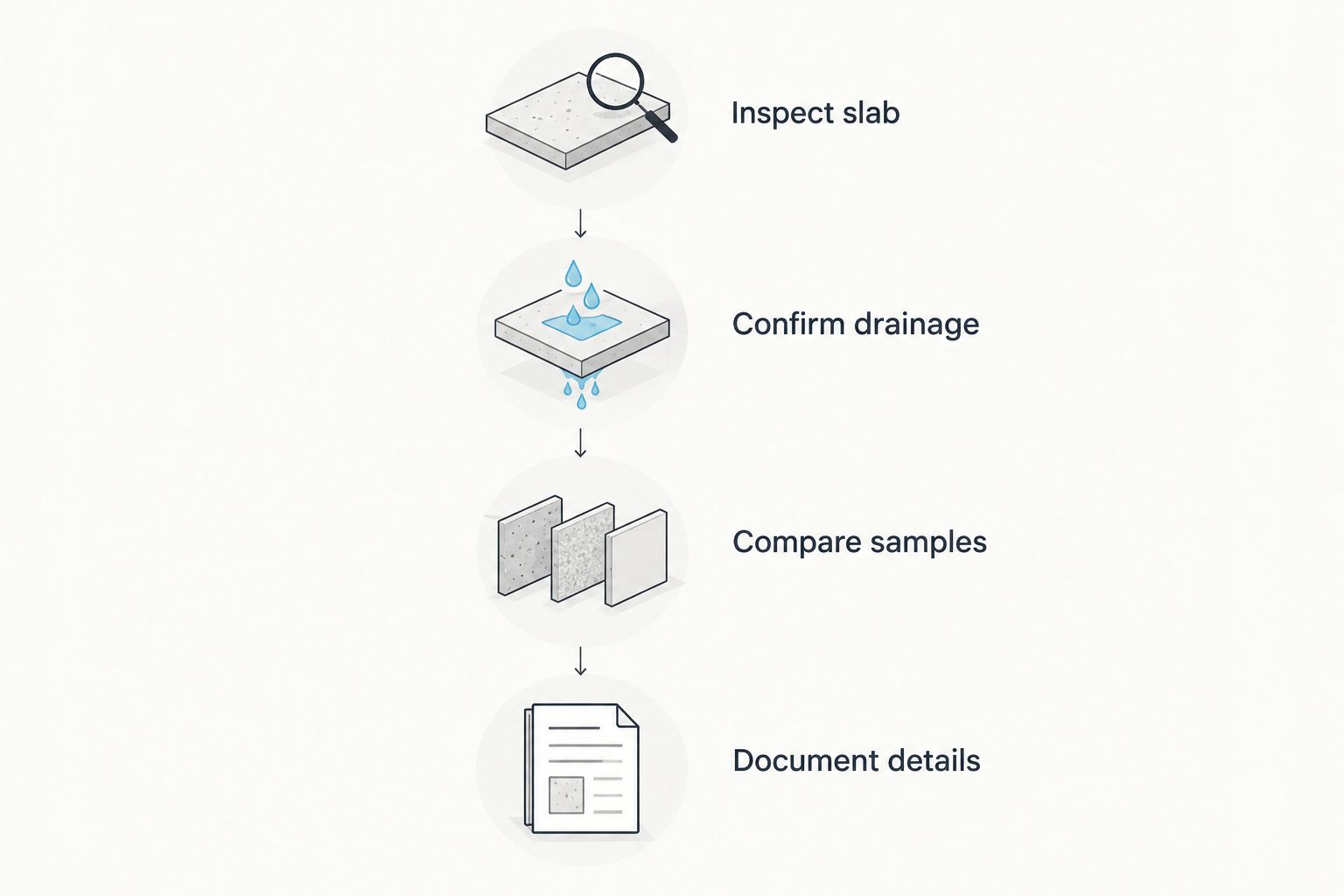
Finish selection belongs after the basic construction questions. Use this sequence to keep a decorative decision from hiding a drainage or slab problem.
Inspect slab
If you are keeping existing concrete, identify cracks, settlement, scaling, and drainage problems before discussing a new surface treatment. An overlay is a separate system, not simply a different finish applied to any existing driveway.
Use the comparison of concrete driveway repair methods to frame the repair discussion. Resolve the underlying condition before choosing how the surface should look.
Confirm drainage
Show where water should leave the driveway and where it must not collect. For scale, a 2% slope drops about 1/4 inch per foot; that calculation illustrates grade, not a universal slope requirement for every driveway.
The garage threshold, street connection, neighboring property, and local requirements determine the actual design. A finish cannot correct the wrong elevations.
Compare samples
Compare the proposed texture with the intended sealer and color treatment. Look at the samples dry and wet, and ask how the finished driveway will be cleaned and maintained.
For decorative concrete, record which sample is approved. A broad description such as “stone look” leaves too much room for disagreement.
Document details
Record the finish, joint layout, curing approach, sealer if specified, and instructions for putting the driveway into use. Conventional saw-cut contraction joints commonly use a minimum depth of one-quarter of the slab thickness: a 4-inch slab corresponds to a 1-inch cut under that rule.
That example does not specify an adequate driveway thickness or cover every jointing method. The project specification must address the actual slab, loads, joint system, and site conditions.
Bring these decisions into the proposal rather than relying on verbal descriptions. A named finish tells you less than a sample paired with a clear construction scope.
Which concrete driveway finish should you choose?
Choose broom-finished concrete if you are undecided. It answers the everyday-use brief without making the driveway depend on a decorative pattern.
Choose exposed aggregate when visible stone is the main design goal. Choose stamped concrete when the pattern is essential to the house’s appearance. Choose sand-washed concrete when you want fine texture without prominent stone or imprints.
Creteform Construction’s concrete driveway finishes recommendation is to approve the surface as a complete assembly: texture, color treatment, sealer where specified, drainage, and joints. Do not judge those decisions separately and assume they will work together.
FAQ
What’s the best concrete driveway finish for Virginia homes in 2026?
Broom-finished concrete is the default recommendation for everyday use. It provides directional texture without a decorative imprint, but drainage, jointing, and concrete construction still determine whether the driveway is properly specified.
Is stamped concrete better than broom-finished concrete?
Stamped concrete is better for a decorative pattern, while broom-finished concrete is the stronger default for a restrained, functional surface. Compare the intended sealed surfaces rather than assuming either finish guarantees wet traction.
Is exposed aggregate uncomfortable to walk on?
Exposed aggregate can feel rough underfoot, especially with coarse stone or deeper exposure. Approve a representative physical sample if barefoot use matters to your household.
Can a new finish fix cracks in my driveway?
A finish alone does not correct the cause of cracking or settlement. Assess the existing slab and choose an appropriate repair or replacement approach before selecting a surface treatment.
Does every concrete driveway need sealer?
Sealer requirements depend on the finish and the specified surface system. Ask which product is proposed, why it is needed, how it affects wet traction, and what preparation is required before future applications.
Is smooth troweled concrete a good driveway finish?
A smooth, hard-troweled surface is not the default choice for an exposed driveway where wet traction matters. Choose an exterior finish based on the actual site, expected use, and complete surface treatment.
What should I ask before approving a driveway finish?
Ask for the proposed texture, a representative sample, the drainage and joint layouts, and written curing and use instructions. Creteform Construction recommends resolving these details before approving the decorative appearance.
One last thing
For a 2026 driveway project, ask to see the approved sample wet—not just dry. Water and sealer can change the appearance, and a wet sample prompts the traction discussion that a dry photograph leaves out. Approve the surface you will use, not just the finish name.
Related guides